Fancy Colored Diamonds
Fancy colored diamonds explained: how GIA grades intensity, what really drives value, and how to choose natural color diamonds for an engagement ring.
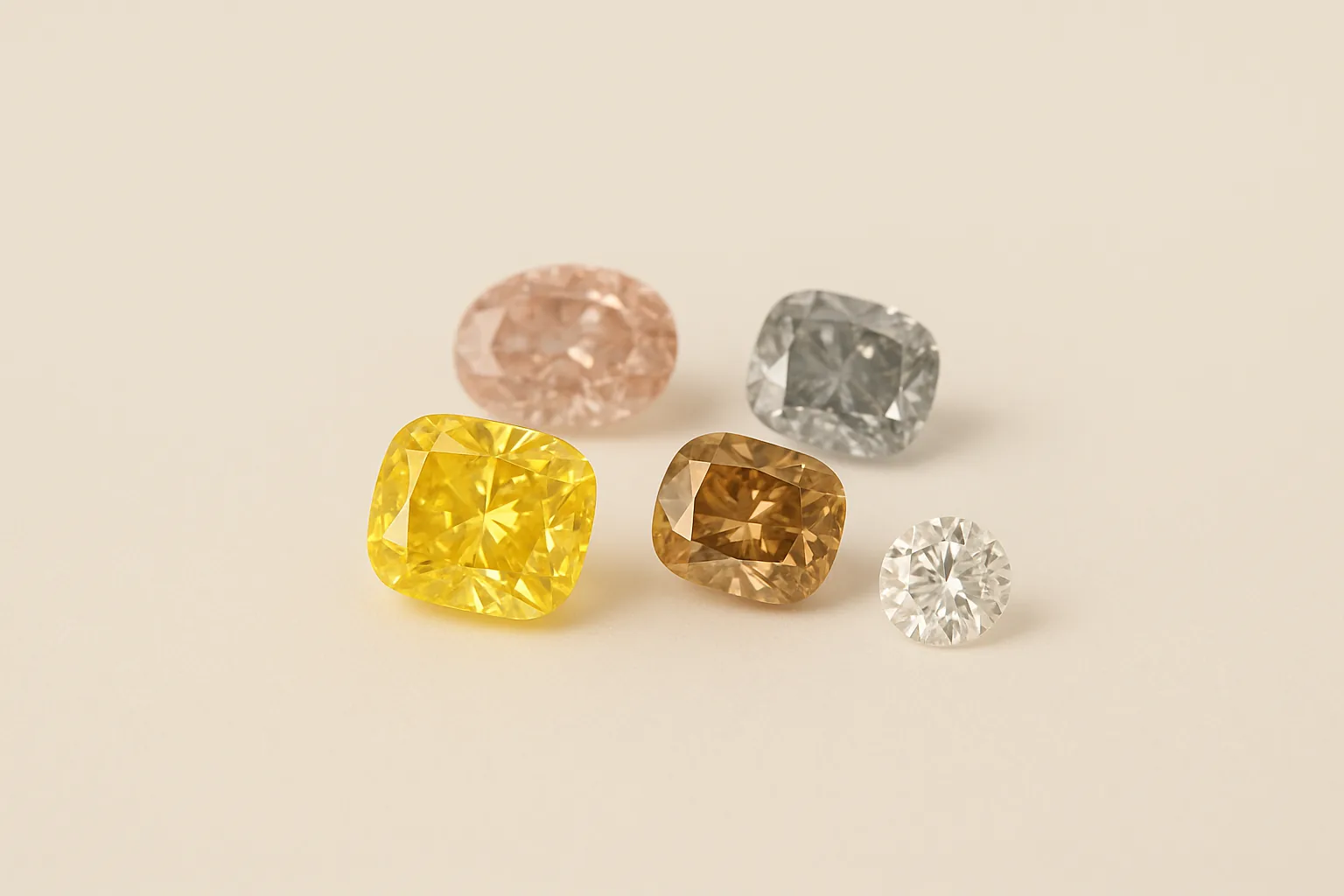
Most diamonds are valued for what they lack. The standard scale runs from D, meaning completely colorless, down to Z, and every step toward Z is a step down in price. Fancy colored diamonds break that logic entirely, because they are valued for exactly what the scale was built to penalize.
Once a diamond's color is more saturated than Z, it leaves the normal scale and enters its own. It stops being a stone with a flaw and becomes a stone with a character, priced on how much color it has rather than how little.
What Are Natural Fancy Colored Diamonds?
A fancy colored diamond is any diamond whose body color falls outside the D-to-Z range, or which shows a hue other than yellow or brown at any intensity. A faintly yellow stone is a Z. A stone yellower than Z is a Fancy Light Yellow, and it is worth more, not less.
Rarity is the reason. Industry estimates put naturally colored stones at roughly one in every ten thousand diamonds mined, and the genuinely saturated ones are a small fraction of that. For the strongest colors in the rarest hues, the world's annual production can be counted in individual stones.
Where the Color Comes From
Color in a diamond is not a coating and not an inclusion. It is a property of the crystal itself, created while the stone was forming, and each hue has its own cause.
- Yellow comes from nitrogen atoms substituting for carbon in the lattice, absorbing blue light and leaving yellow behind.
- Blue comes from boron, which also makes these stones semiconductors, a quirk no other diamond shares.
- Pink, red and brown come from plastic deformation: the lattice was physically distorted under pressure, and the resulting defect absorbs light. No trace element is involved.
- Green comes from natural irradiation by the surrounding rock over millions of years, and the color is often confined to a thin surface layer.
- Black comes from clouds of inclusions dense enough to stop light, typically graphite, pyrite or hematite, rather than from a body color at all.
Understanding the GIA Color Grading Scale for Fancy Diamonds
The four Cs still apply, but their order of importance inverts. On a colorless stone, cut drives beauty and color is a subtraction. On fancy colored diamonds, color drives everything and the other three are largely in service of it.
How the Four Cs Shift
- Color accounts for the overwhelming share of value. A single intensity grade can multiply the price several times over, far more than any clarity movement would.
- Clarity matters much less. Body color and the way these stones are cut both mask inclusions, so buyers routinely accept grades they would reject in a colorless diamond.
- Cut is chosen to deepen color rather than to maximize brilliance. It is why so many fancy color stones are cushions, radiants and ovals: those outlines hold light in the stone longer and let it pick up more color.
- Carat interacts with color, because a larger stone gives light a longer path and therefore looks more saturated at the same grade.
The Intensity Grades
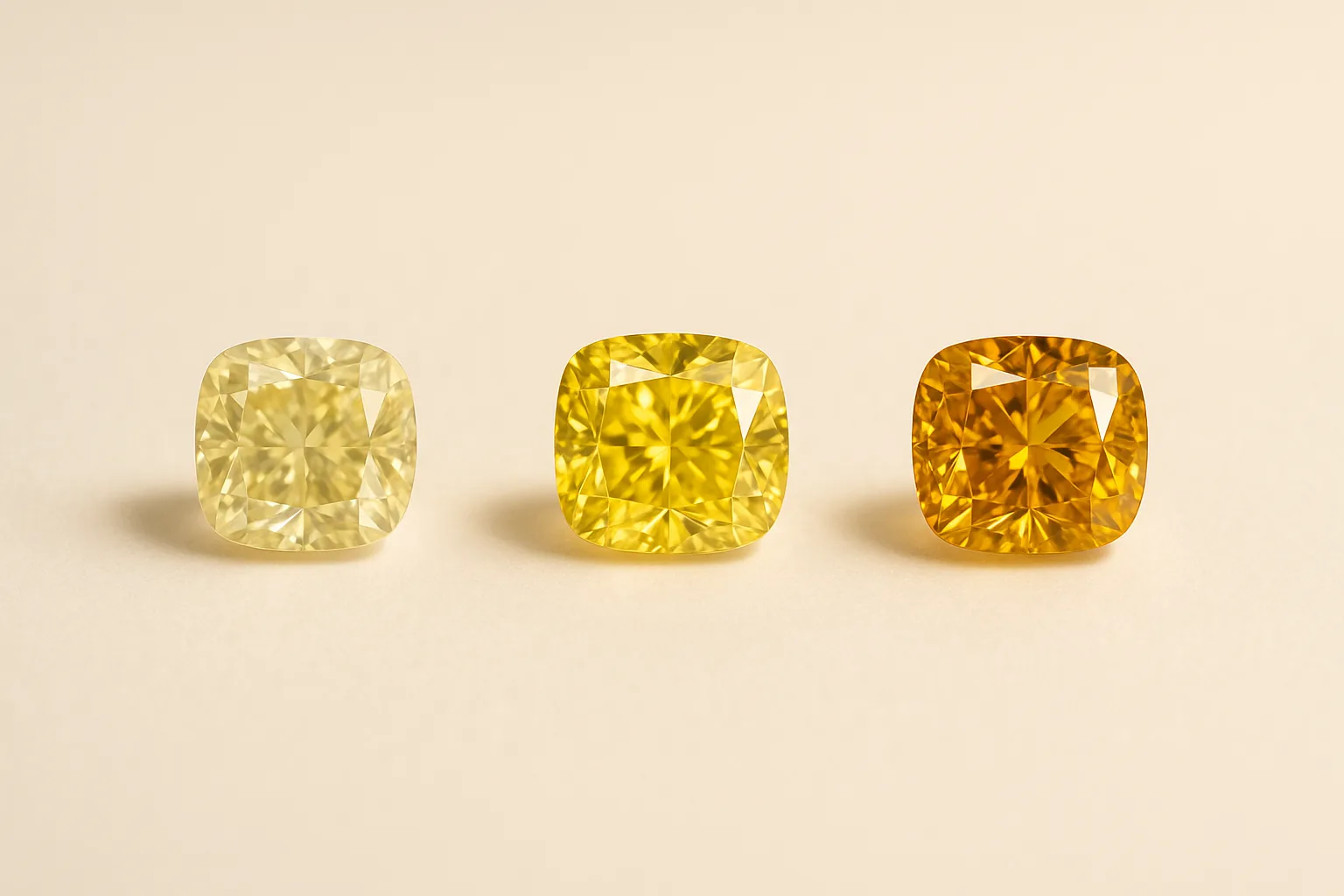
GIA grades fancy color on hue, tone and saturation together, and the resulting grades run:
- Faint
- Very Light
- Light
- Fancy Light
- Fancy
- Fancy Intense
- Fancy Vivid
- Fancy Deep and Fancy Dark
Two points are worth knowing before you shop. The first three grades apply only to hues other than yellow and brown, since a faintly yellow diamond is still graded on the D-to-Z scale. And the scale is not a simple ladder: a fancy vivid diamond is the peak of saturation, while Fancy Deep and Fancy Dark describe stones darker in tone rather than stronger in color.
One more practical difference: colorless diamonds are graded face down against white, while fancy colors are graded face up, the way you will actually see the stone on a hand.
Popular Fancy Diamond Colors and Who They Suit
Yellow and the Canary Yellow Diamond Ring
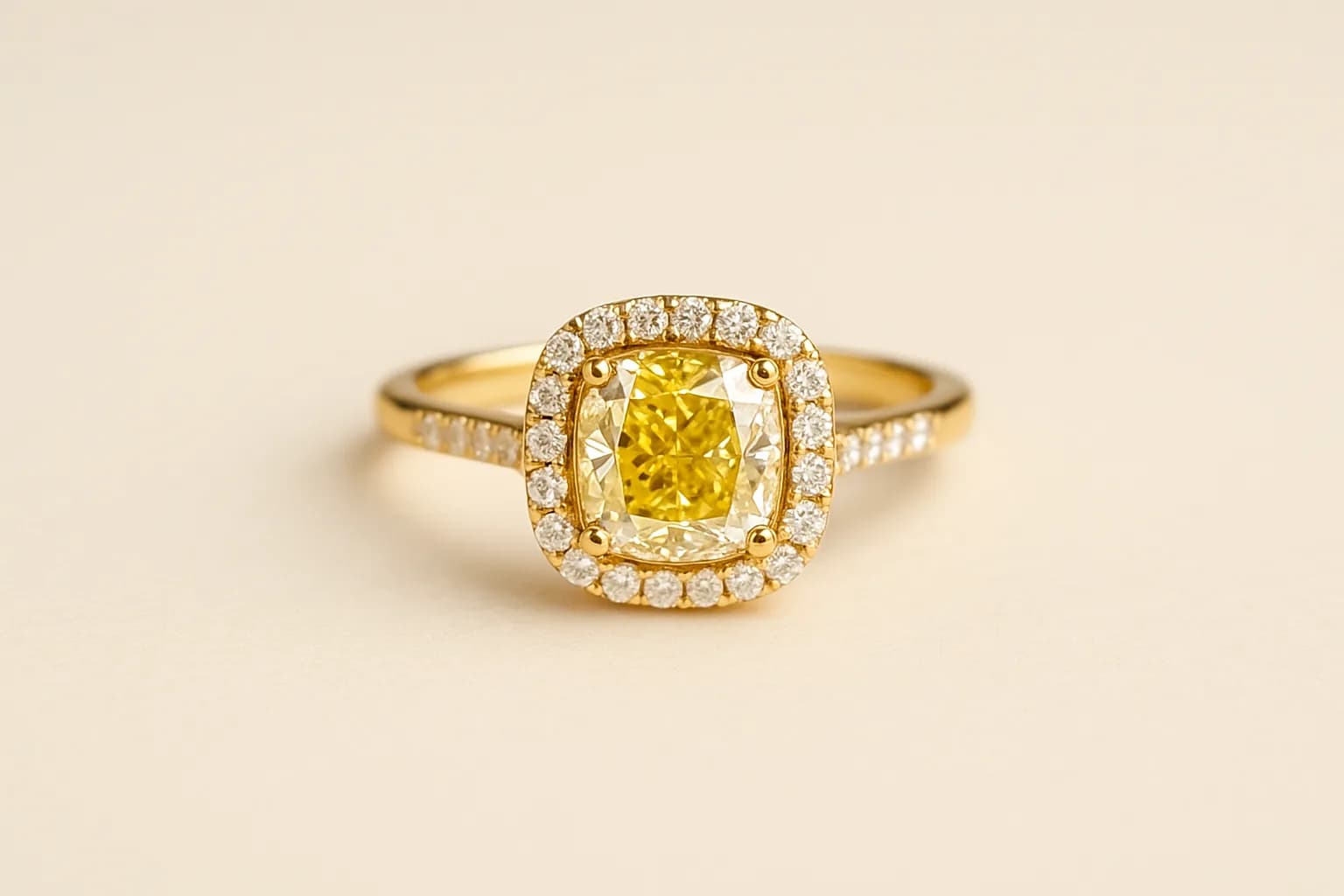
Yellow is the most available fancy color and the natural way into the category. It is also where the language gets loose: "canary" is a trade term for a strongly saturated yellow, not a GIA grade, so a canary yellow diamond ring may hold anything from a Fancy Intense to a Fancy Vivid Yellow. Ask for the grade, not the nickname.
The appeal is warmth. A vivid yellow reads as sunlight rather than as a compromise, and because supply is comparatively healthy, yellow offers real presence at a fraction of what the rarer hues command.
Pink and Red Diamonds
Pink is the color that turned diamonds into an investment story. The Argyle mine in Western Australia produced the overwhelming majority of the world's pink diamonds and closed in November 2020, removing the primary supply of a stone that was already scarce.
Red is scarcer still. True Fancy Red diamonds, with no modifying hue, are known in only a handful of examples worldwide, and most stones sold as red are more accurately purplish red or pinkish red. A pink diamond engagement ring is one of the few pieces of jewelry where scarcity is structural rather than a marketing position.
Blue Diamonds
Blue is the regal end of the category and among the rarest of the widely recognized hues. Boron-bearing diamonds are geologically uncommon, and large clean examples are exceptional enough that individual stones have names and histories. The Hope Diamond is the one everyone knows, and it is a Fancy Deep grayish blue rather than the electric blue people picture.
Champagne, Cognac and Brown
Brown diamonds are the most common fancy color and the most quietly wearable. The trade grades them from light champagne through to deep cognac, and those words come from mine and dealer scales rather than from GIA. Warm, organic and comparatively affordable, they suit anyone who finds a colorless stone too clinical.
Black and Green Diamonds
Black diamonds are opaque rather than transparent, taking their color from inclusions so dense that light cannot pass. Set against white metal they give a graphic, modern contrast that no other stone quite matches.
Green is the connoisseur choice and the hardest to verify, because natural irradiation and laboratory irradiation produce similar results. A natural green diamond always warrants a report from a major laboratory, and the origin of color matters more here than anywhere else in the category.
Fancy Diamond Engagement Rings: Choosing Color Over Convention
Fancy diamond engagement rings answer a question colorless stones cannot: what would a ring look like if it were only about the two people involved? A colorless solitaire is beautiful and universal, and universality is precisely what some couples want to avoid. A color is a decision, and decisions carry stories.
There is a practical argument too. Because clarity is weighted less heavily, a colored stone often delivers more visible presence for the money than an equivalent colorless one, provided color is what you are buying.
Metal Pairings That Work
Metal is not decoration here. It sits directly against the stone and changes how saturated the color appears.
- Yellow gold with yellow diamonds reinforces the hue and makes a Fancy or Fancy Intense read stronger than it grades.
- Rose gold with pinks does the same, which is why so many pink diamond engagement rings are set this way.
- Platinum or white gold does the opposite, giving a neutral surround that maximizes contrast. For blues, greens and vivid yellows this is usually the right answer.
- Two-tone prongs, colored against the stone and white against the shank, let you have both.
Custom Engagement Ring Settings for Colored Centers
- Halo settings with colorless accents are the most reliable way to intensify a center stone, because the eye judges color by comparison and a ring of white makes the center look deeper.
- Bezels wrap the girdle in metal and suit black and cognac stones, where a hard outline serves the graphic quality.
- Three-stone designs with colorless side stones frame the color without competing with it.
- Closed or tinted backs are traditional in colored stone setting, though a good modern cut rarely needs the help.
Because so few colored stones come in standard sizes, custom engagement ring settings are the norm rather than the exception. The stone is found first and the ring is built around it, which is the reverse of how most colorless rings are bought.
Rarity, Value and Investment Potential
Rare colored diamonds behave differently from colorless ones in the market, for one straightforward reason: supply cannot respond to demand. Colorless production can be increased. A pink diamond cannot be, and the closure of Argyle showed what happens when the single dominant source of a color stops producing.
- Value concentrates in the top grades. Fancy Vivid and Fancy Intense stones in the rare hues have the strongest record; lighter grades in common hues behave like ordinary jewelry.
- Certification is not optional. Color origin, natural against treated, is the single largest value factor, and only a report from a major laboratory settles it.
- Jewelry is illiquid. These are heirlooms that hold value well, not instruments you can sell on demand.
Buy a stone because you want to look at it for fifty years. If it also holds its value, treat that as the second reason rather than the first.
Finding the Right Stone
Fancy colored diamonds reward buyers who learn the vocabulary. Color outranks clarity, intensity grades drive price more than any other factor, "canary" and "cognac" are trade language rather than grades, and the report matters more here than in any other diamond purchase.
The rest is personal. The right stone is the one whose color you keep looking back at. To see what is available, browse the fancy diamond collection (opens in new tab), or start from the ring setting and design your own ring (opens in new tab) around it.