Tsavorite
Greener than most emerald, brighter, tougher and never treated. How it compares, why large stones barely exist, and what it costs per carat.
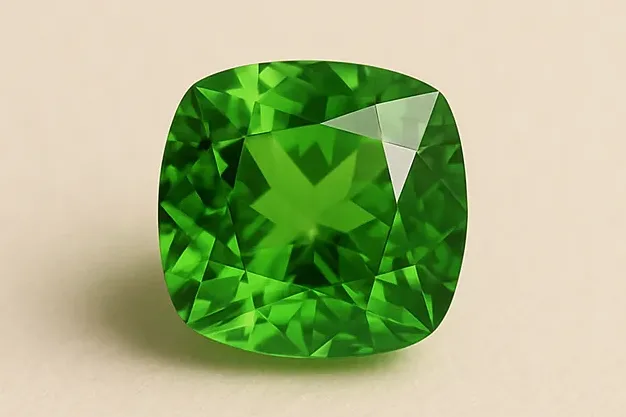
Tsavorite is a green garnet, and it is the strongest argument in the coloured stone trade that name recognition and quality are not the same thing. It is greener than most emerald, brighter than all of it, tougher, cleaner, and it is never treated. It also costs less, because far fewer people have heard of it.
It was found in 1967 in Tanzania by the Scottish gemmologist Campbell Bridges, then again in 1971 across the border in Kenya, and it was named by Tiffany's Henry Platt after Tsavo, the national park that spans the region. Like tanzanite it comes from a very small part of East Africa and nowhere else in commercial quantity.
This page covers what the colour comes from, how it genuinely compares with emerald, why it is almost never found in large sizes, what it costs, and how to avoid confusing it with the other green garnet it is regularly mixed up with.
What it is, and where the colour comes from
Tsavorite is grossular garnet, coloured green by traces of vanadium and chromium. Those are the same elements that colour emerald, which is why the two can look so alike, and why the trade sometimes describes tsavorite as having emerald colour with garnet behaviour.
Because the colour comes from trace elements rather than from structure, it varies: the range runs from a slightly yellowish grass green through pure vivid green to a deeper, slightly bluish green. The most valued is a strongly saturated pure green with no brown and no grey, and unlike emerald the finest material is rarely dark.
Garnets are singly refractive, meaning they have no double refraction and no pleochroism. The stone shows you one colour from every direction, which is a genuine practical advantage: there is no orientation trap of the kind that makes tanzanite and sapphire difficult to cut and to judge.
Tsavorite against emerald
This comparison is the reason to consider the stone at all, so it is worth doing honestly rather than as a sales pitch:
| Property | Tsavorite | Emerald |
|---|---|---|
| Hardness | 7 to 7.5 | 7.5 to 8 |
| Toughness | Good, no cleavage | Poor, brittle with inclusions and cleavage |
| Treatment | None known or used | Oiling or resin filling is near universal |
| Typical clarity | Often eye-clean | Inclusions expected and accepted |
| Brilliance | Higher refractive index, noticeably livelier | Lower, softer and more velvety |
| Available sizes | Mostly under 2 ct, rare above 5 ct | Large stones available |
Emerald is harder on the Mohs scale and tsavorite is tougher in practice, which sounds contradictory and is not. Hardness resists scratching; toughness resists breaking. Emerald's typical inclusions and its cleavage make it the more fragile stone in a ring despite the higher number, and the fact that it is nearly always oiled means it also needs more careful handling in a workshop.
Where emerald wins outright is scale and recognition. A five carat tsavorite is a genuinely rare object, while a five carat emerald is merely expensive, and a great many buyers want the word emerald rather than a better green stone. That is a real preference and there is nothing wrong with it, but it is what you are paying for.
Not to be confused with demantoid
Demantoid is the other fine green garnet, and it is a different species: andradite rather than grossular. It is softer at around 6.5 to 7, but it has extraordinary dispersion, higher than diamond, which gives it rainbow fire that tsavorite does not have. Russian demantoid often contains horsetail inclusions, which are a mark of origin and raise the price rather than lowering it.
The two are frequently listed loosely as green garnet. If the fire matters to you, or if you are being quoted a price that seems high for tsavorite, establish which species is on the table.
The size problem
Tsavorite crystals form under conditions that fractured them heavily, so most rough breaks down into small clean pieces rather than large ones. The practical result is that the overwhelming majority of cut tsavorite is under one carat, two carat stones are already notable, and anything over five carats is a serious rarity that a specialist dealer would remember.
Price per carat therefore rises very steeply with size, more steeply than in almost any other coloured stone. A two carat stone can cost three or four times per carat what a half carat stone of identical colour costs. When comparing quotes, compare like sizes or the numbers will mislead you badly.
Where it comes from
The Tsavo region spanning southern Kenya and northern Tanzania, and in commercial terms essentially nowhere else. Mining is largely small-scale and difficult, working narrow and unpredictable veins, which is a large part of why supply is inconsistent and why large stones stay scarce.
Origin is not a price factor in the way it is for ruby or sapphire. There is no equivalent of a Kashmir premium here, and a laboratory report will confirm the species without needing to argue about the country. Judge the colour.
Hardness and everyday wear
At 7 to 7.5 with no cleavage plane and good toughness, tsavorite is a genuinely practical ring stone, better suited to daily wear than emerald, tanzanite, opal or moonstone. It has no treatment to worry about damaging, which also means it tolerates normal jewellery workshop procedures without special instructions.
It is still a coloured stone rather than a sapphire, so it will pick up surface scuffing over decades on a hand that meets a lot of hard surfaces. Our guide to settings covers the options, and a tsavorite is one of the few stones in this series where a classic raised solitaire is a perfectly defensible choice.
What it costs
Colour first, then size, with the size effect unusually strong. In dollars per carat:
| Quality | Under 1 ct | 1 to 2 ct | Over 2 ct |
|---|---|---|---|
| Yellowish or greyish green, included | $200 - $500 | $400 - $900 | $800 - $1,500 |
| Good vivid green, eye-clean | $600 - $1,200 | $1,200 - $2,500 | $2,500 - $5,000 |
| Top saturated pure green, fine cut | $1,500 - $2,500 | $3,000 - $6,000 | $6,000 - $12,000 and up |
Those numbers sit above most of this series and below fine emerald of comparable colour, which is roughly the honest position of the stone in the market. It is not a bargain stone. It is a well-priced one relative to what it delivers.
Meaning and symbolism
Garnet is the January birthstone, and tsavorite is a garnet, so it is a legitimate and much more interesting January choice than the deep red almandine most people picture. The January page covers the family.
Garnet tradition across most cultures runs to constancy, safe return and steady commitment, which are unusually apt associations for an engagement stone. Tsavorite itself is too recently discovered to have accumulated its own folklore, and anyone offering you ancient tsavorite lore is improvising.
Designing around a tsavorite
- It can take a classic setting. With no cleavage and good toughness, a raised solitaire or a six-prong is fine here, which is not true of most stones on this list. Our settings guide covers the range.
- Yellow gold warms it, white metal sharpens it. Green against yellow gold reads richer; against platinum or white gold it reads cleaner and cooler. Our metals guide has the comparison.
- Diamond accents work unusually well. The high brilliance of tsavorite holds its own beside white diamond rather than being flattened by it.
- Buy the colour before the size. Given how steeply price rises with weight, a vivid one carat stone is usually a better object than a dull two carat one at the same money.
- Ask for the species in writing. Green garnet covers tsavorite, demantoid and several less valuable stones.
A short buying checklist
- Confirm the species: tsavorite grossular garnet, not simply green garnet.
- Compare quotes at the same carat weight, since price per carat climbs steeply with size in this stone.
- Check for a window by tilting the stone, which shows where weight was kept at the expense of brilliance.
- Ask whether there is any treatment. The answer should be no, and if it is anything else, ask what and why.
- Judge the green for brown and grey, which are what separate a good stone from an ordinary one.
- For anything substantial, ask for a report from an independent laboratory naming the species.
Frequently asked questions
Is tsavorite better than emerald? Tougher, cleaner, brighter and untreated, yes. Emerald has the name, the history and the large sizes. Which is better depends entirely on which of those you are buying.
Is tsavorite treated? No. There is no known or commercially used treatment for it, which is one of its genuine advantages over emerald and over most coloured stones.
Why is it so expensive for a garnet? Because it is nothing like common garnet in either rarity or colour. The material comes from one small region, and clean crystals large enough to cut are scarce.
Is it hard enough for an engagement ring? Yes. At 7 to 7.5 with no cleavage it is one of the more practical stones in this series for daily wear.
What is the difference between tsavorite and demantoid? Different garnet species. Demantoid is softer but has extreme dispersion and rainbow fire; tsavorite is harder and shows pure colour without the fire.
Why can I not find a large one? The rough fractures heavily as it forms, so big clean pieces are genuinely rare. Anything above five carats is a specialist item.
Does origin affect the price? Not meaningfully. Kenyan and Tanzanian material is judged on colour, and there is no origin premium comparable to sapphire's.
How do I clean it? Warm water, mild soap and a soft brush. It is untreated and durable, so ultrasonic cleaning is generally safe unless the stone is visibly included.
To see how it sits against the rest of the coloured stones, the semi-precious stones guide compares the series side by side, and we are happy to answer questions directly (opens in new tab).