Moissanite
Lab-grown, 9.25 on the Mohs scale, and two and a half times the fire of diamond. Why it is sold by millimetre, and how to avoid the one common mistake.
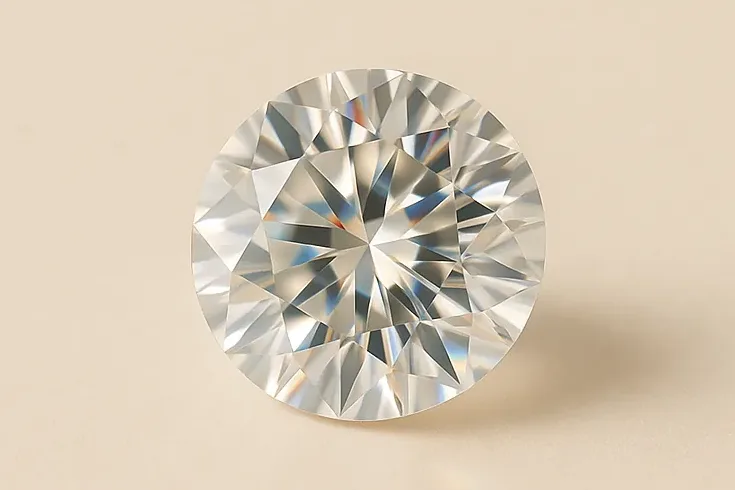
Moissanite is silicon carbide, and it was first identified in 1893 by Henri Moissan in a meteorite crater in Arizona. Natural moissanite is so rare that it has never been a gem material in any meaningful sense. Essentially every moissanite you will ever see was grown in a laboratory.
That is not a criticism, and it should not be buried. It is the central fact about the stone, and any page that skirts around it is selling rather than explaining. What matters is what the material actually does, which is throw more fire than a diamond while costing a fraction of one.
This page covers how moissanite differs from diamond optically, why it is sold by millimetre rather than carat, and what to look at before buying loose.
What moissanite looks like
Modern moissanite is colorless or near colorless, equivalent to roughly D to F on the diamond scale. Earlier generations carried a distinct yellow or green cast, and stones from the 1990s and 2000s still circulating on the second-hand market often show it.
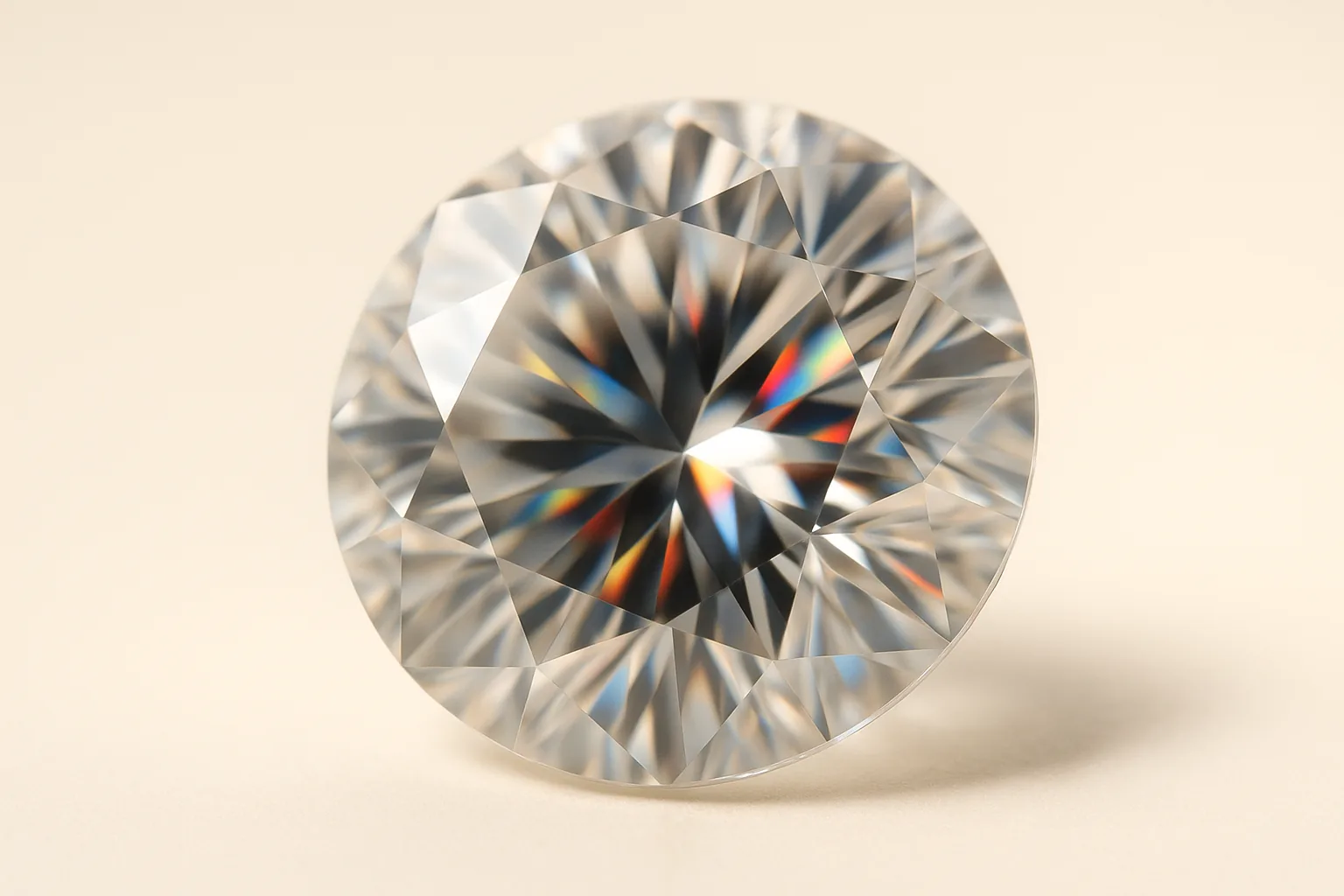
The defining optical property is dispersion, the splitting of white light into spectral colors, which is what jewellers call fire.
- Dispersion 0.104, against diamond's 0.044. Moissanite throws roughly two and a half times the fire, in visible rainbow flashes.
- Refractive index 2.65 to 2.69, against diamond's 2.42. It returns more light, so it reads as brighter.
- Doubly refractive, unlike diamond. In larger stones you can see facet edges appear doubled through the crown if you look closely.
- Mohs 9.25, harder than every gemstone except diamond itself.
Where moissanite comes from
A laboratory. The material is grown from silicon carbide, a process pioneered commercially by Charles and Colvard, whose patent expired in 2015 and opened the market to many producers. Quality varies between them, and the difference shows in color and in clarity.
Natural moissanite does exist, in meteorites and in a handful of terrestrial deposits, in crystals far too small to cut. If a stone is offered as natural moissanite, treat that claim with considerable scepticism.
Hardness and everyday durability
At 9.25 on the Mohs scale, moissanite is harder than sapphire and second only to diamond. It has no cleavage. For practical purposes it is close to indestructible in ordinary wear, and it will hold its polish for decades.
This is genuinely its strongest argument. Among affordable alternatives to diamond, nothing else combines this hardness with this durability, and it will not scratch, chip or dull the way a softer substitute will.
Treatment, and the honest comparison
Moissanite is not treated, because it does not need to be: it is grown to specification. There is no heat, no irradiation and no filling, and nothing to disclose.
The comparison worth making is with lab-grown diamond, not with moissanite pretending to be diamond. Both are laboratory materials sold at a fraction of natural diamond prices. A lab-grown diamond is chemically and optically a diamond. Moissanite is a different mineral with different optics, and the choice between them is a choice about what you want the stone to look like. Our page on natural and lab-grown diamonds covers that side of it.
What separates a good moissanite from a poor one
Because the material is manufactured, the variables are narrower than for a mined stone, and two of them matter far more than the rest.
Color
Insist on colorless. Modern premium material is D to F equivalent, and there is no reason to accept the yellowish or greenish cast of older or cheaper production. This is the single most common disappointment with moissanite and it is entirely avoidable.
Cut
Cut matters more here than in diamond, because the extraordinary dispersion can tip from beautiful into garish if the stone is badly proportioned. Well cut moissanite is spectacular. Poorly cut moissanite looks like costume jewelry, and the difference is entirely in the proportions.
Clarity
Good material is eye-clean and should be. Manufacturing control means clarity problems are a sign of cheap production rather than of nature, so there is little reason to compromise.
Size, and why it is sold by millimetre
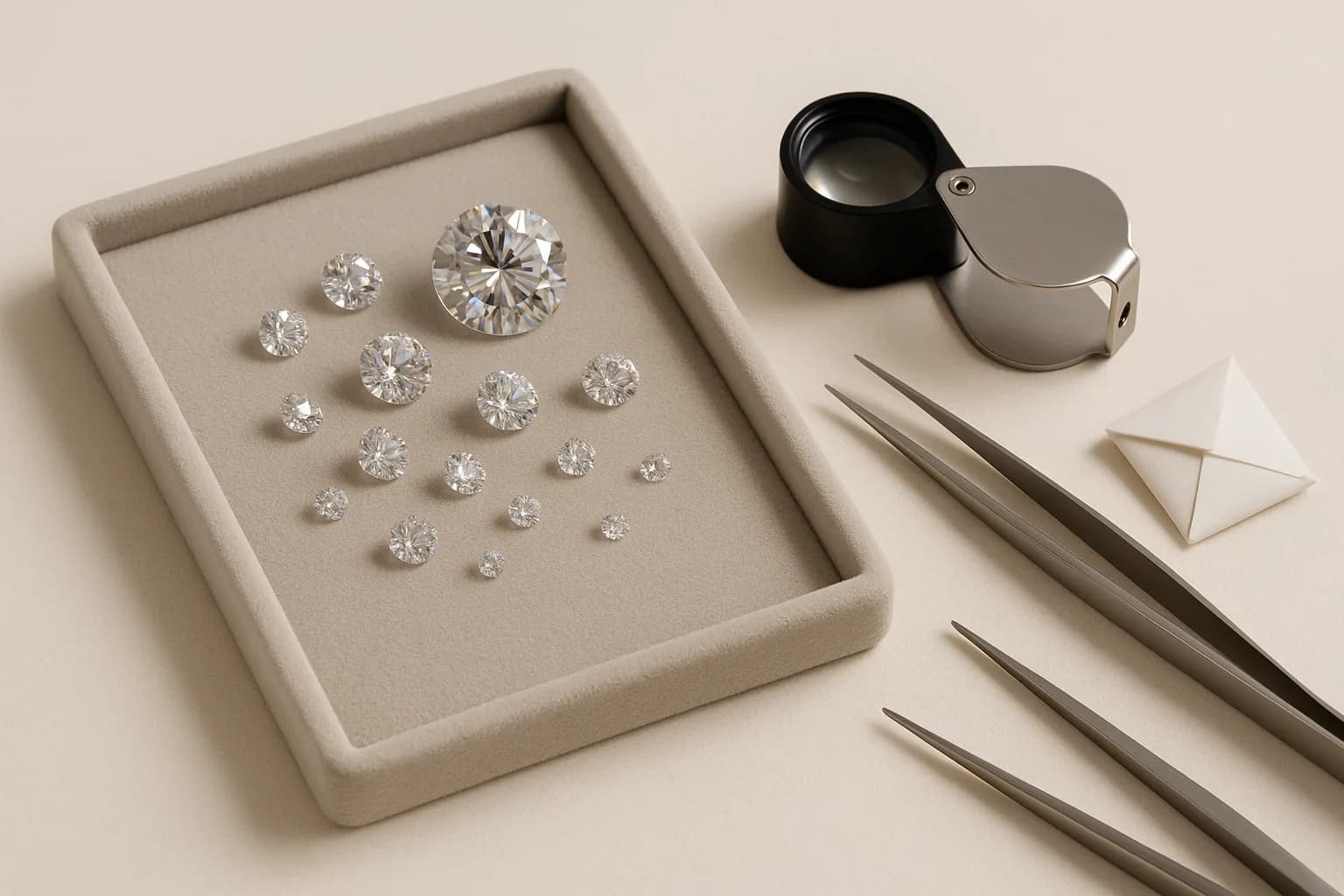
Moissanite is less dense than diamond, so a stone of the same physical size weighs less. A 6.5 millimetre round moissanite looks like a one carat diamond but weighs closer to 0.88 carats. For that reason the trade sells moissanite by millimetre diameter rather than by carat weight, and comparing carat figures between the two materials will mislead you. Compare millimetres.
What loose moissanite costs
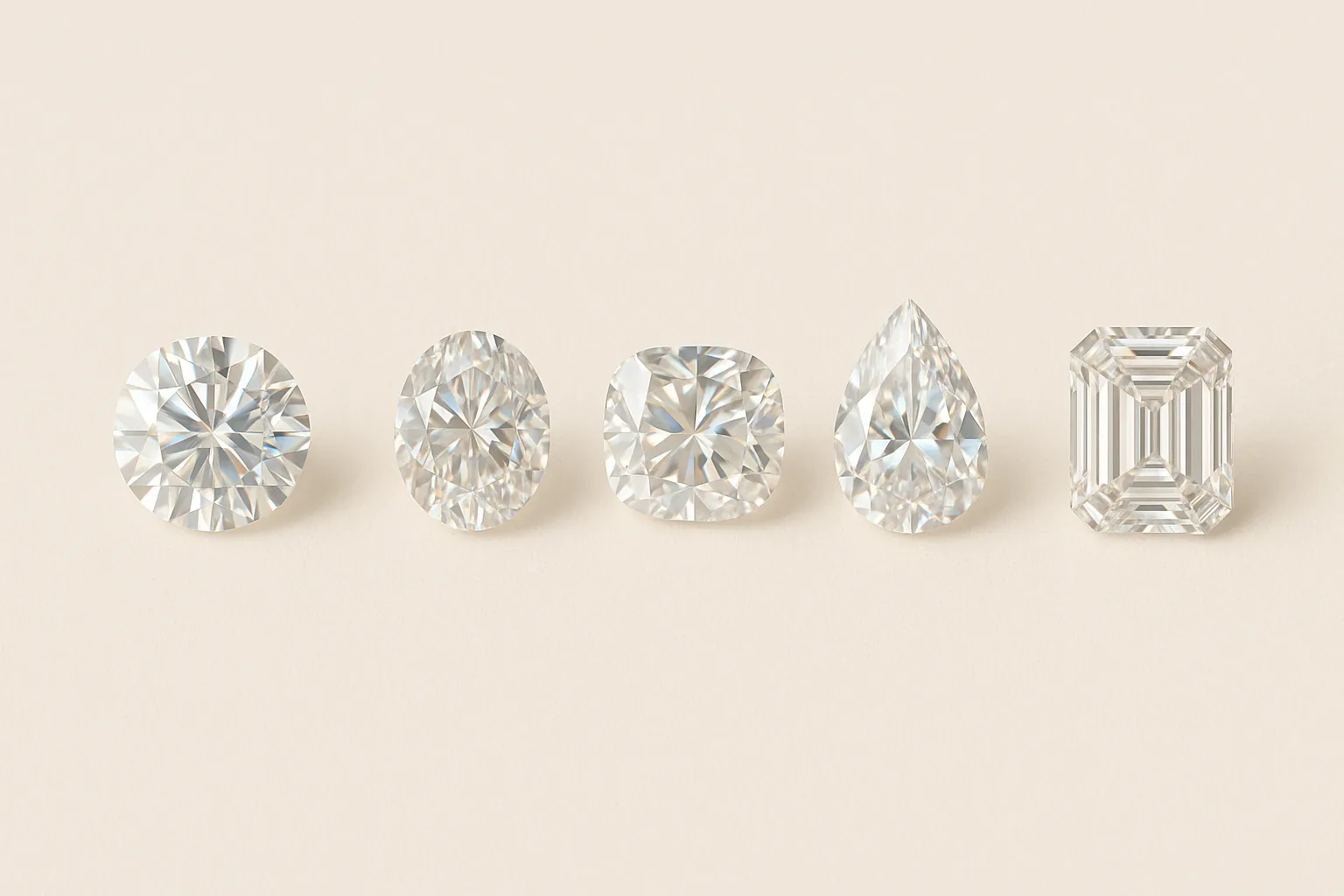
A fraction of natural diamond, typically under a tenth for a comparable look, and meaningfully less than lab-grown diamond. Prices vary by producer, and the premium brands charge for consistency of color and cut rather than for anything in the material itself.
- Colorless grade is the main price lever and the one worth paying for.
- Cut quality decides whether the fire reads as beautiful or as gaudy.
- Size is affordable, so the constraint is taste rather than budget.
- Compare by millimetre, not carat. Carat comparisons across materials mislead.
What it means, and who it suits
Moissanite has no folklore, being a modern laboratory product with a name attached to a chemist. What it has is a clear modern argument: maximum durability and maximum brilliance for minimum money, without any of the ethical questions attached to mining.
It suits people who want a large, hard, brilliant colorless stone and are untroubled by it not being a diamond. It does not suit people who want a diamond, and no amount of enthusiasm will change that. Being clear about which you are is the whole decision.
Why buy the stone loose
The two things that separate good moissanite from bad, its color and the quality of its cutting, are precisely the things a finished setting and a product photograph conceal.
Bought loose, both are stated for the individual stone: the colourless grade it was made to, and the proportions it was cut to.
- You confirm it is colorless. The commonest disappointment, and stated per stone.
- You know the cut is right. Proportions decide whether the fire reads beautiful or garish.
- You compare by millimetre. The only comparison against a diamond that means anything.
- You choose the setting separately. Quieter mounts suit a stone that throws this much fire.
Designing around a loose moissanite
Anything a diamond can do, structurally. At 9.25 with no cleavage, moissanite imposes no setting constraints, and prongs, bezels, halos and tension settings are all appropriate.
One aesthetic note: because moissanite throws so much colored fire, quieter settings tend to serve it better than busy ones. A simple solitaire lets the stone do the work; a heavily accented design competes with it. See ring settings and choosing a metal, or go to design your own ring (opens in new tab).
A short buying checklist
- Insist on colorless, D to F equivalent. Do not accept a yellow or green cast.
- Compare sizes in millimetres, never in carats, against a diamond.
- Look at it in daylight, not only under shop lighting.
- Judge the cut. Proportions decide whether the fire is beautiful or garish.
- Ask who produced it. Consistency varies by manufacturer.
- Decide honestly whether you want this stone or a diamond, before you buy either.
Frequently asked questions
Is moissanite a real gemstone? Yes, it is a real mineral, silicon carbide. Almost all of it is laboratory grown, because natural moissanite occurs only in meteorites and rare terrestrial deposits in crystals too small to cut. Lab-grown does not mean fake; it means manufactured rather than mined.
Is moissanite a fake diamond? No. It is a different mineral with different optical properties, and it is not an imitation of anything. It is often chosen as an alternative to diamond, which is a different matter from pretending to be one.
How can you tell moissanite from diamond? Moissanite is doubly refractive, so facet edges can appear doubled when viewed through the crown of a larger stone. It also shows far more colored fire. Thermal testers cannot distinguish the two because both conduct heat well; an electrical conductivity tester will.
Is moissanite harder than diamond? No. Moissanite is 9.25 on the Mohs scale and diamond is 10, so diamond is harder. Moissanite is harder than every other gemstone, including sapphire, and is extremely durable in practice.
Why is moissanite sold by millimetre instead of carat? Because it is less dense than diamond, so the same physical size weighs less. A 6.5 millimetre round moissanite looks like a one carat diamond but weighs about 0.88 carats. Comparing millimetres is the only meaningful comparison across the two materials.
Does moissanite get cloudy over time? No. It does not degrade, discolour or cloud. Like any stone it will collect skin oils and look dull until cleaned, which takes soap and water.
Does moissanite have a color tint? Modern premium material is colorless, roughly D to F equivalent. Older and cheaper production often shows a yellow or green cast, and this is the most common complaint about the stone. Buy colorless and the problem disappears.
Is moissanite better value than lab-grown diamond? It is cheaper, and it is harder than everything except diamond. Whether it is better value depends on whether you want the extra fire moissanite gives or the optical character of a diamond. They are different-looking stones at different prices.
Does moissanite hold its value? No, and neither does lab-grown diamond. Manufactured materials have no supply constraint, so resale value is minimal. Buy it because you want to wear it, not as a store of value.
Is moissanite good for an engagement ring? Very. It is exceptionally hard, has no cleavage, is brilliant, and costs a fraction of a diamond. The only question worth settling first is whether you want a diamond, because moissanite is not one. See our guide to designing an engagement ring.
To see what is available, browse the loose moissanite collection (opens in new tab), or start from a design and create your own ring (opens in new tab) around a stone. If you are weighing moissanite against a diamond, contact us (opens in new tab) and we will talk you through the difference, which settles it faster than any description.