Garnet
Garnet is a family, not a stone: vivid green tsavorite, orange spessartine, raspberry rhodolite. A buying guide to the varieties, prices and what to check.
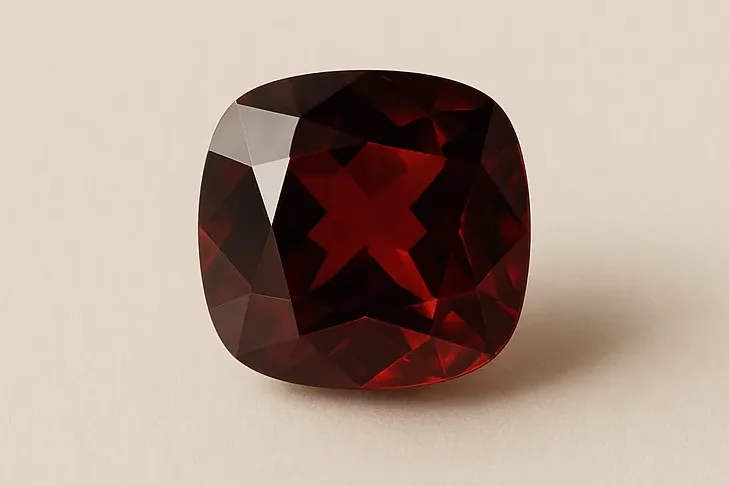
Most people picture garnet as a dark red stone from a Victorian brooch. That is one garnet out of many, and it is the least interesting one. Garnet is not a mineral but a family of them, and between its members it produces vivid orange, brilliant green, purple-red, cinnamon brown and stones that change colour entirely between daylight and lamplight.
It also has one quality almost nothing else in the coloured stone world can claim: garnet is essentially never treated. No heat, no oil, no irradiation. What formed underground is what you are buying, which puts it in a very small club alongside untreated spinel.
This page maps the family, explains why the price range runs from pocket money to serious investment, and covers what to check before buying loose.
The colors of garnet
Every colour except blue in ordinary light, and even that exists in the rare colour-change material found in Madagascar in the 1990s. The colour depends on which member of the family you are holding, and the names below are species and varieties rather than marketing.
- Almandine and pyrope. The familiar deep reds. Abundant, affordable and the reason garnet has its reputation.
- Rhodolite. A purplish red to raspberry pink blend of pyrope and almandine. Brighter and more open than plain red, and excellent value.
- Tsavorite. Vivid green grossular, found in Tanzania in 1967 and named by Tiffany. Rivals fine emerald and is rarer, with prices to match.
- Demantoid. Green andradite, and the one with a genuine claim to fame: its dispersion exceeds that of diamond, so it throws more fire.
- Spessartine. Vivid orange, often sold as mandarin garnet. Glowing and increasingly sought.
Where garnet is mined
East Africa dominates the interesting end. Tanzania produces tsavorite and fine spessartine, Namibia and Mozambique contribute strongly, and Madagascar is the source of the colour-change material. Sri Lanka, Brazil and India supply large volumes of the common reds.
Demantoid has two classic origins that carry a premium: the Ural Mountains in Russia, where stones often contain the fibrous inclusion called a horsetail that collectors specifically want, and Namibia. A horsetail inclusion in a demantoid is one of the few cases in gemmology where a visible inclusion raises the price.
Hardness and everyday durability
Garnet ranges from about 6.5 to 7.5 on the Mohs scale depending on species, with the common reds toward the upper end and demantoid a little softer. There is no cleavage anywhere in the family, which matters more than the number: garnet chips far less readily than its hardness alone suggests.
It is stable in light, unaffected by ordinary household chemicals and requires no special handling. Demantoid, being softer and more valuable, deserves a protective setting. For everything else, garnet is one of the most practical coloured stones you can wear daily.
Treatment, or the absence of it
Garnet is one of the very few gems that reaches the market essentially untreated. It does not respond usefully to heat, it is not oiled, and it is not irradiated. The colour in the stone is the colour the earth made.
This is worth more than it sounds. On most coloured stones a significant part of the buying conversation is about what has been done to them and whether it was disclosed. With garnet that conversation barely exists, which removes the largest single source of uncertainty in coloured stone buying. If a seller volunteers that a garnet has been treated, ask what and why, because it is not normal practice.
What separates a good garnet from a great one
Which factors matter depends on which garnet, and the spread across the family is wider than for any other gem in this series.
Color
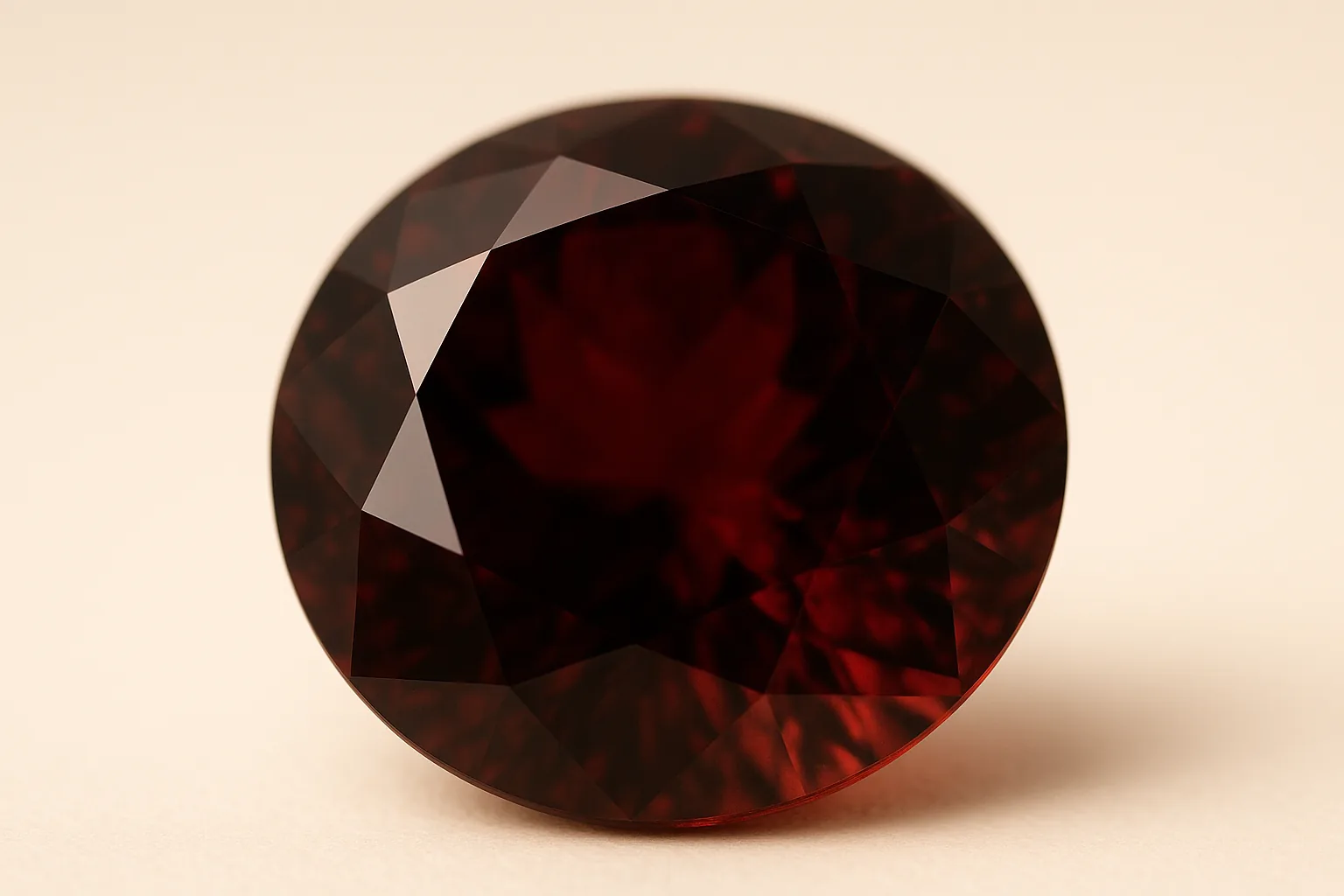
For tsavorite, a vivid slightly bluish green with no brown is the target and the premium is steep. For spessartine, a pure saturated orange without brown. For the reds, brightness matters more than depth: many common garnets are so dark they read almost black, and an open, lively red is worth considerably more than a deep murky one.
Clarity
The reds and rhodolite are typically clean and should be eye-clean. Tsavorite is often included, and a small amount is tolerated in exchange for colour. Demantoid is the exception that proves the rule: a horsetail inclusion is desirable and adds value, which is unique.
Cut
Garnet has a high refractive index, which means a well cut stone returns a lot of light and looks brighter than its colour alone would suggest. Deep, dark reds are frequently cut too deep, compounding the problem. Insist on seeing a stone face up. Our page on diamond cut covers the optics, which apply to any transparent gem.
Carat weight
Common red garnet is available large and cheaply. Rhodolite is reasonable into double digits. Tsavorite above two carats is genuinely scarce and above five is exceptional, with prices rising steeply. Demantoid is scarce in any size.
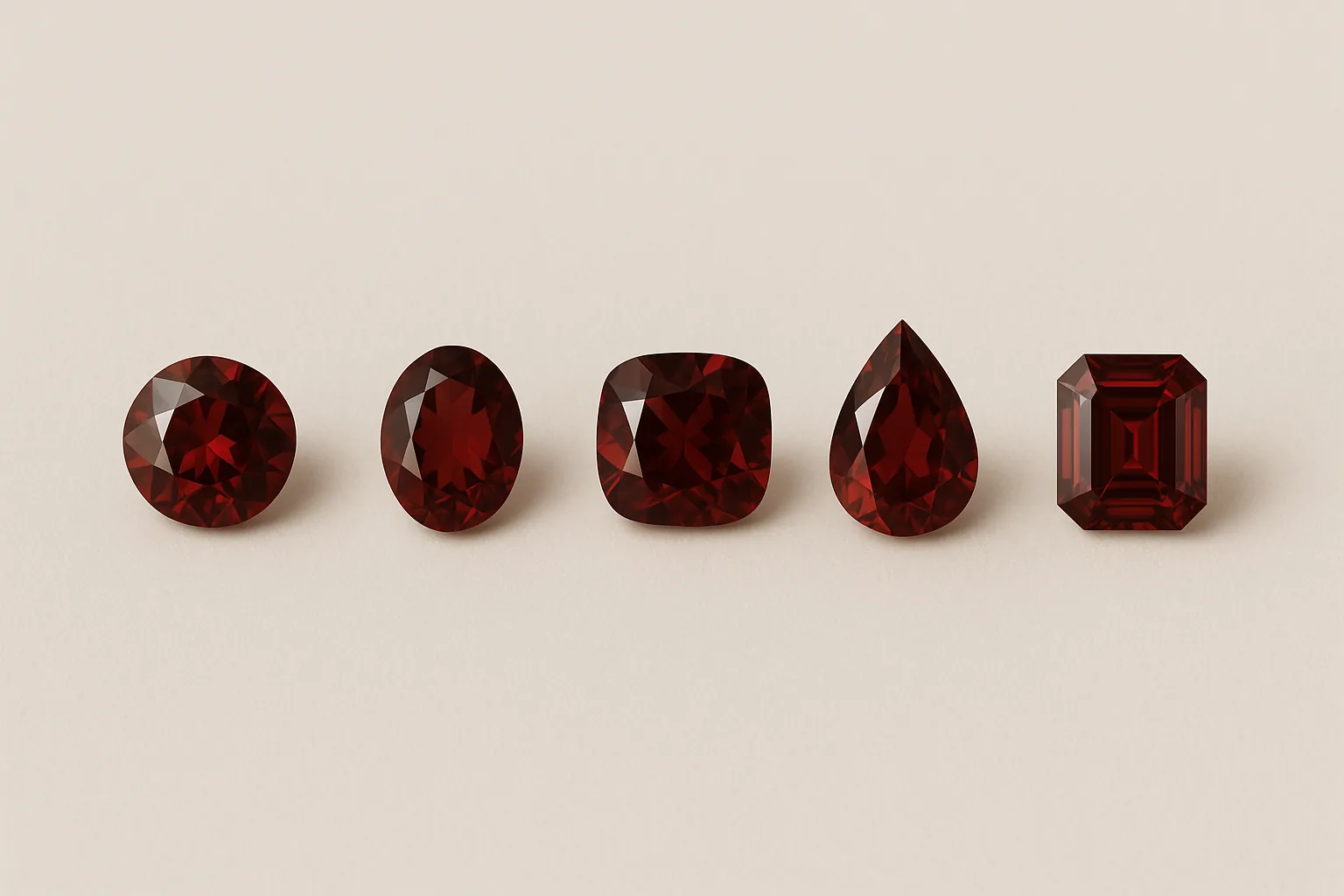
What loose garnet costs
No other family in this series spans such a range. Almandine and pyrope are among the least expensive faceted gems. Rhodolite is modest. Spessartine of good colour is a serious stone. Fine tsavorite and demantoid reach prices comparable with good sapphire and, in the top grades, with emerald.
- Which member of the family sets the bracket before anything else.
- Brightness rather than depth is what to look for in the reds.
- Cut quality matters especially on dark material, where it is often neglected.
- Untreated is the default, so it commands no premium here. It is simply what garnet is.
Meaning, symbolism and the January birthstone
Garnet takes its name from the Latin granatum, pomegranate, for the resemblance between deep red crystals and the seeds. It has been associated with protection on journeys since antiquity, and was carried by travellers and soldiers for exactly that reason. It is a traditional second anniversary gift.
It is the birthstone for January. See our January birthstone page for the fuller story, or the guide to birthstones by month.
Why buy the stone loose
With garnet the case is specific: the common reds are frequently cut too deep and read as black once set, and a finished ring will not tell you so. Bought loose, brightness is part of how the stone is described.
For the scarcer members, buying loose means the colour is stated for the stone rather than helped along by a metal chosen to flatter it.
- You know whether it is bright or dead. The single most common fault in garnet.
- You judge colour honestly. Not through a mount picked to help it.
- You compare family members. Rhodolite against red is a revelation.
- You build around your stone. Unusual colours deserve designs made for them.
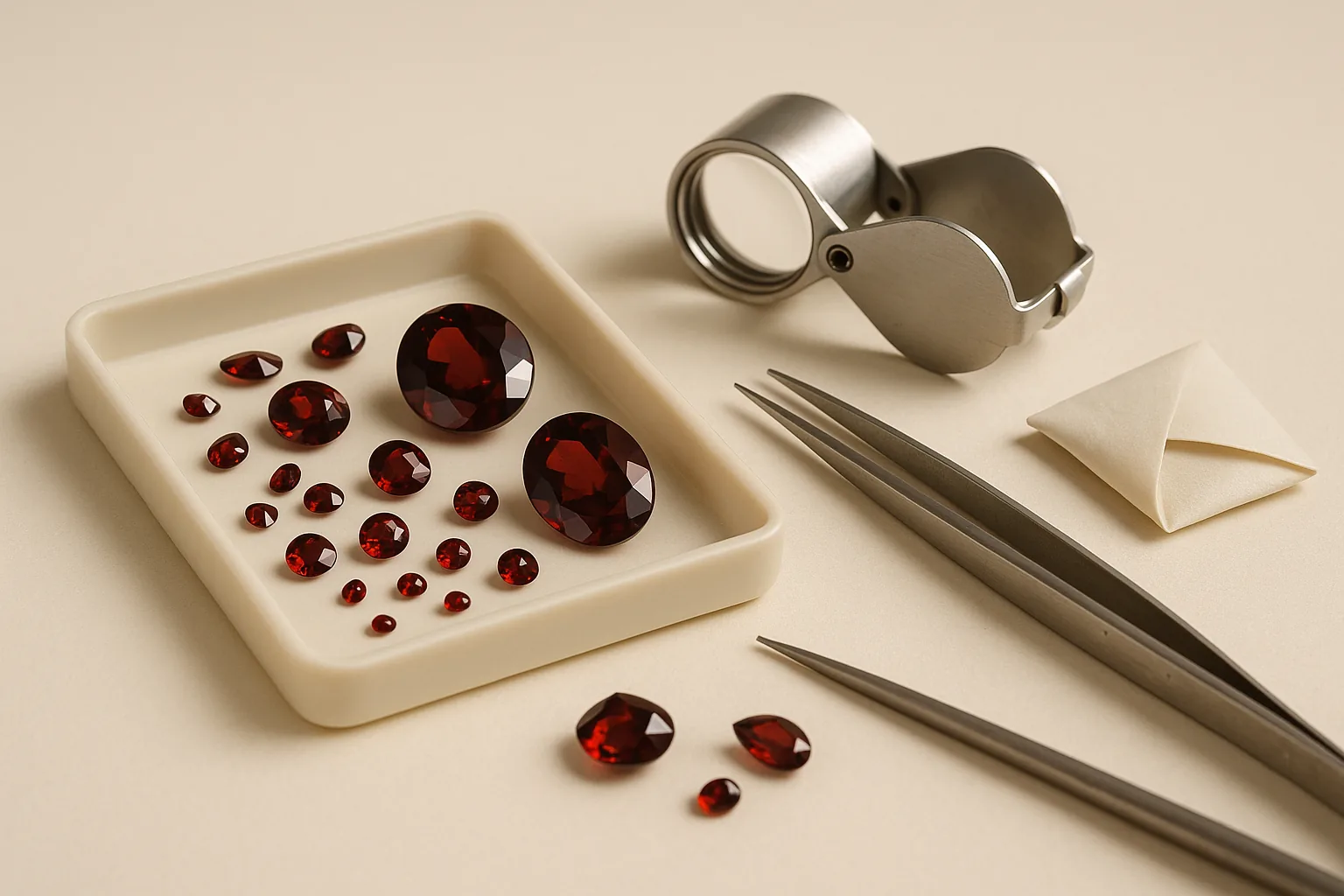
Designing around a loose garnet
Yellow gold is the traditional partner for the reds and warms them further. White metals do more for rhodolite and for spessartine, keeping the colour clean and preventing the warmth from tipping into brown. Tsavorite belongs in white metal, where nothing competes with the green.
Given garnet has no cleavage, setting is less constrained than for topaz or morganite, and prongs are perfectly safe. See ring settings and choosing a metal, or start at design your own ring (opens in new tab).
A short buying checklist
- Hold red stones face up against white and check they are not simply dark.
- Look for brown in green and orange material, which kills the price.
- Judge tsavorite clarity against tsavorite, not against a clean red.
- For demantoid, ask about the horsetail, which adds rather than subtracts.
- Expect untreated. Ask why if a seller says otherwise.
- Establish which family member you are being offered before discussing price.
Frequently asked questions
Is garnet always red? No. Garnet is a family of related minerals that produces almost every colour: vivid green tsavorite and demantoid, orange spessartine, purplish red rhodolite, cinnamon hessonite, and rare colour-change material. Red is simply the most common and cheapest.
Is garnet treated? Essentially never. Garnet does not respond usefully to the treatments applied to other gems, so it reaches the market as it came out of the ground. That is unusual and it removes the biggest uncertainty in coloured stone buying.
What is tsavorite? A vivid green grossular garnet, found in Tanzania in 1967 and named by Tiffany after Tsavo National Park. It rivals emerald in appearance, is rarer than emerald, and is priced accordingly.
What is demantoid, and why does it sparkle so much? A green andradite garnet whose dispersion, the property that splits white light into spectral colours, is higher than diamond. It therefore shows more fire than a diamond of the same size, which is why collectors prize it.
Why do inclusions increase the value of some demantoid? Because a specific fibrous inclusion called a horsetail identifies classic Russian Uralian material. It is one of very few cases in gemmology where a visible inclusion raises rather than lowers price.
How hard is garnet? Between about 6.5 and 7.5 depending on which member of the family. More importantly it has no cleavage, so it resists chipping better than the number suggests and is practical for daily wear.
Why do some garnets look almost black? Because they are cut too deep, usually to retain weight from dark rough. A well cut stone of the same material looks bright and open. Always view a red garnet face up before buying.
What is rhodolite? A purplish red to raspberry garnet, a natural blend of pyrope and almandine. It is brighter and more open than common red garnet, and it is among the best value in the whole family.
How should I clean garnet jewelry? Warm water, mild soap and a soft brush. Most garnet tolerates ultrasonic cleaning, but avoid it on demantoid and on any stone with visible fractures.
Can garnet be used in an engagement ring? Yes. The absence of cleavage and reasonable hardness make it practical, and the colour range means you are not limited to red. See our guide to designing an engagement ring.
To see what is available, browse the loose garnet collection (opens in new tab), or start from a design and create your own ring (opens in new tab) around a stone. Garnet varies more than almost any gem, so contact us (opens in new tab) and we will help you work out which member of the family you actually want.