Cat's Eye
The stone chatoyancy is named after. How to judge the eye for sharpness and centring, the milk and honey test, and why a cheap cat's eye is quartz.
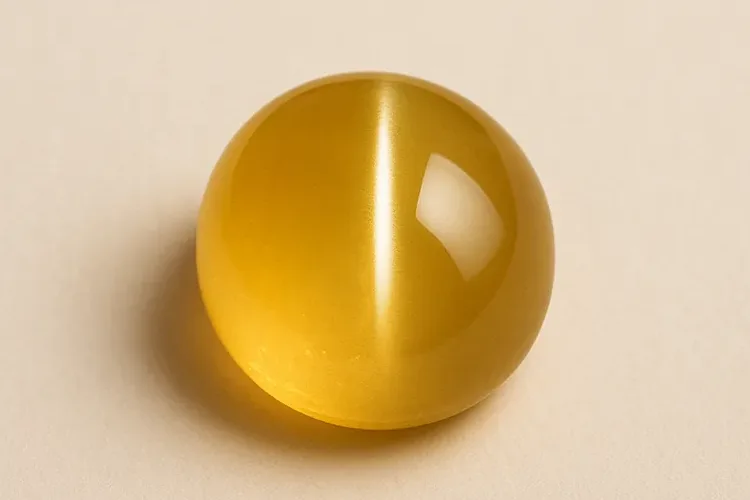
Cat's eye chrysoberyl is the stone the effect is named after. A single bright line crosses the dome of the cabochon, and when the stone is turned the line glides across the surface like the slit pupil it is named for. Gemmologists call the effect chatoyancy, and this is the one gem that shows it well enough to have taken the word.
It matters that the name is precise. In the gem trade, cat's eye with no other word attached means chrysoberyl and nothing else. Every other chatoyant stone has to be qualified: cat's eye quartz, cat's eye tourmaline, cat's eye apatite. A listing that just says cat's eye and prices it low is almost certainly selling one of those.
This page covers what makes the eye, how to judge a good one from a poor one, why the stone is always cut as a cabochon, what it costs, and the milk and honey test that separates a fine stone from a merely nice one.
What makes the eye
The stone is full of microscopic needle-like inclusions, all lying parallel to one another. Each needle reflects a thin sliver of light, and because they are aligned, all those slivers add up into a single bright band running at right angles to the needles. Move the light or the stone and the band moves with it.
The trade calls those inclusions silk. This is the one place in gemmology where inclusions are the entire point: a chrysoberyl clean enough to facet has no eye at all, and a stone dense enough to show a sharp eye would be graded heavily included by any other measure. The stone is worth more for the flaw.
Two things follow from that. The cutter has to orient the dome so the needles run across it rather than along it, which wastes rough and is why fine cat's eyes are small. And the stone must be cut as a cabochon, because facets would break the curved surface the band needs in order to travel.
Judging the eye
Almost all of the value sits in the quality of the band itself, and five things decide it:
| Factor | What to look for |
|---|---|
| Sharpness | A crisp line with defined edges, not a soft blurred glow |
| Centring | The band sitting down the middle of the dome, not off to one side |
| Straightness | A straight, unbroken line across the full width of the stone |
| Opening and closing | The band should split into two and close again cleanly as the stone turns |
| Contrast | A bright white band against a deep body colour, not band against pale |
The single most useful test is the one the trade calls milk and honey. Hold a single light source to one side of the stone: on a fine cat's eye the half nearer the light turns milky white and the half away from it stays deep honey gold, with the eye as the sharp line between them. A stone that stays the same colour on both sides has a weak eye, whatever the photographs suggest.
Buying it without holding it
Every one of those tests needs a single point of light and movement, which a still photograph cannot give you. Ask the seller for a short video: the stone turning slowly under one light, filling the frame. If the eye is sharp it will snap across the dome. If it is soft, it will smear, and no amount of still photography will hide that in motion.
Be wary of images shot under two or more lights. Multiple sources produce multiple faint bands, which can make a mediocre stone look busy and bright while hiding that no single band is crisp.
Colour
Body colour runs from a pale greenish yellow through honey and amber to a deep brown. The most valued is a rich golden honey, warm rather than greenish, because it gives the strongest contrast against the white band.
Greenish stones are common and cost less. Very dark brown stones can carry a beautiful sharp eye but the contrast is muted, so they are usually cheaper than their eye quality alone would suggest. That makes dark stones with sharp eyes one of the better value corners of this market.
Hardness and everyday wear
Cat's eye chrysoberyl is 8.5 on the Mohs scale with excellent toughness and no easy cleavage direction, exactly like its faceted relative. Only corundum and diamond are harder among stones you will meet in jewellery.
That makes it genuinely suited to a ring worn daily, which is unusual for a cabochon: most domed stones on the market are softer materials chosen for colour rather than for wear. A cat's eye takes knocks without complaint. Our guide to settings covers the options, and for a cabochon a bezel is both the most secure and the most natural fit.
Where it comes from
Sri Lanka is the historic and still the principal source, and fine Sri Lankan material sets the standard for the golden honey colour. Brazil, India, Madagascar and Tanzania all produce it, with quality varying enormously within each.
Origin is worth much less here than it is for ruby or sapphire. The eye is either sharp or it is not, and that is visible without a laboratory report, so the market prices the stone rather than its passport.
Cat's eye chrysoberyl and alexandrite
Both are chrysoberyl, and they are frequently confused in listings. Alexandrite is the transparent, faceted, colour-changing variety; cat's eye is the included, domed, chatoyant one. Our alexandrite guide covers that side of the family.
There is a rare third thing that is both at once: a cat's eye alexandrite, which shows a band and changes colour. Those are collector stones, priced accordingly, and genuinely scarce rather than merely uncommon.
What it costs
Price is driven by the eye first and the body colour second, with size mattering less than in faceted stones because fine rough is small to begin with. As a broad orientation, in dollars per carat:
| Quality | Under 2 ct | 2 to 5 ct | Over 5 ct |
|---|---|---|---|
| Weak eye, greenish or dull body | $60 - $200 | $150 - $400 | $300 - $800 |
| Sharp eye, good honey colour | $400 - $1,200 | $1,000 - $3,000 | $2,500 - $6,000 |
| Sharp centred eye, fine golden body, milk and honey | $1,500 - $4,000 | $4,000 - $10,000 | $10,000 and up |
Cat's eye quartz, which is the stone most often sold under a loose use of the name, runs from a few dollars to perhaps thirty dollars per carat. If a price looks like that, the stone is quartz whatever the listing says.
Meaning and symbolism
The stone carries a strong protective tradition, and unusually the symbolism is fairly consistent across the cultures that use it. The eye is read as watchfulness, and the stone is worn to deflect harm and to guard what has been earned rather than to attract something new.
In Vedic astrology it is the gem of Ketu, and it is one of the nine stones of the navaratna. That association drives real demand across South and East Asia, and it is a large part of why fine golden material holds its price.
If you are choosing a stone by tradition rather than by eye, our astrology and gemstones guide sets out how the zodiac schemes map onto stones, which is a different system again.
Designing around a cat's eye
- Orientation is the whole job. The band must run across the finger, not along it, or the wearer sees it only from one side. Agree this with the setter before the stone is mounted.
- A bezel suits it. A cabochon has no girdle for prongs to grip cleanly, and a bezel both holds it better and frames the dome. Our settings guide shows the alternatives.
- Keep accent stones quiet. The eye is a thin line of light and it competes badly with a halo of small brilliants. Plain metal serves it better.
- Yellow gold flatters the honey body colour, white metal sharpens the contrast with the band. Both are defensible; our metals guide covers the trade-off.
A short buying checklist
- Ask for video under a single light, with the stone turning. Stills cannot show an eye.
- Check the band is centred, straight and unbroken across the full width of the dome.
- Ask whether the stone shows milk and honey, and ask for the video that demonstrates it.
- Confirm the species in writing: chrysoberyl, not quartz, tourmaline or apatite.
- Ask whether the dome is symmetrical and how deep the base is, since a deep base hides weight that does nothing for the look.
- For anything substantial, ask for a report from an independent laboratory naming the species.
Frequently asked questions
Is cat's eye the same as tiger's eye? No, and the two are worlds apart in value. Tiger's eye is a banded quartz with a broad silky sheen across the whole stone, worth a few dollars. Cat's eye chrysoberyl shows one sharp band and is a fine gem.
Why is my cat's eye so cheap? Almost certainly because it is quartz rather than chrysoberyl. The name is used loosely at the low end of the market, and the price gap between the two is enormous.
Does the eye ever fade? No. It is a structural feature of the stone's inclusions, not a treatment or a coating, and nothing about normal wear affects it.
Can cat's eye be faceted? It can be, but it should not be. Facets break up the curved surface the band travels across, and a faceted stone loses the eye entirely. Every genuine cat's eye is a cabochon.
Is it treated? Rarely, and there is no established treatment that creates or improves an eye. Some material is heated to improve body colour, which should be disclosed.
Is it hard enough for an engagement ring? Yes. At 8.5 with excellent toughness it is one of the most durable cabochon stones available, and better suited to daily wear than most faceted coloured stones.
What is a cat's eye alexandrite? A chrysoberyl that is both chatoyant and colour-changing. They exist, they are genuinely rare, and they are priced as collector material.
How do I clean it? Warm water, mild soap and a soft brush. Avoid ultrasonic cleaners: the stone is heavily included by nature and vibration is unkind to included material.
To see how it sits against the rest of the coloured stones, the semi-precious stones guide compares the series side by side, and we are happy to answer questions directly (opens in new tab).