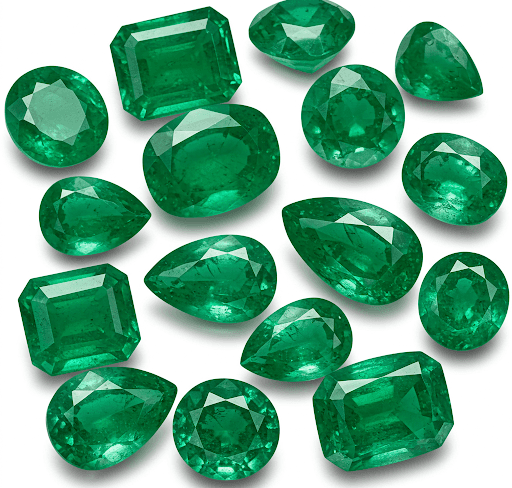
Emerald
Emerald is prized for a green no other stone matches, and almost every one is treated to improve it. Learn what to ask before buying, and its long history.
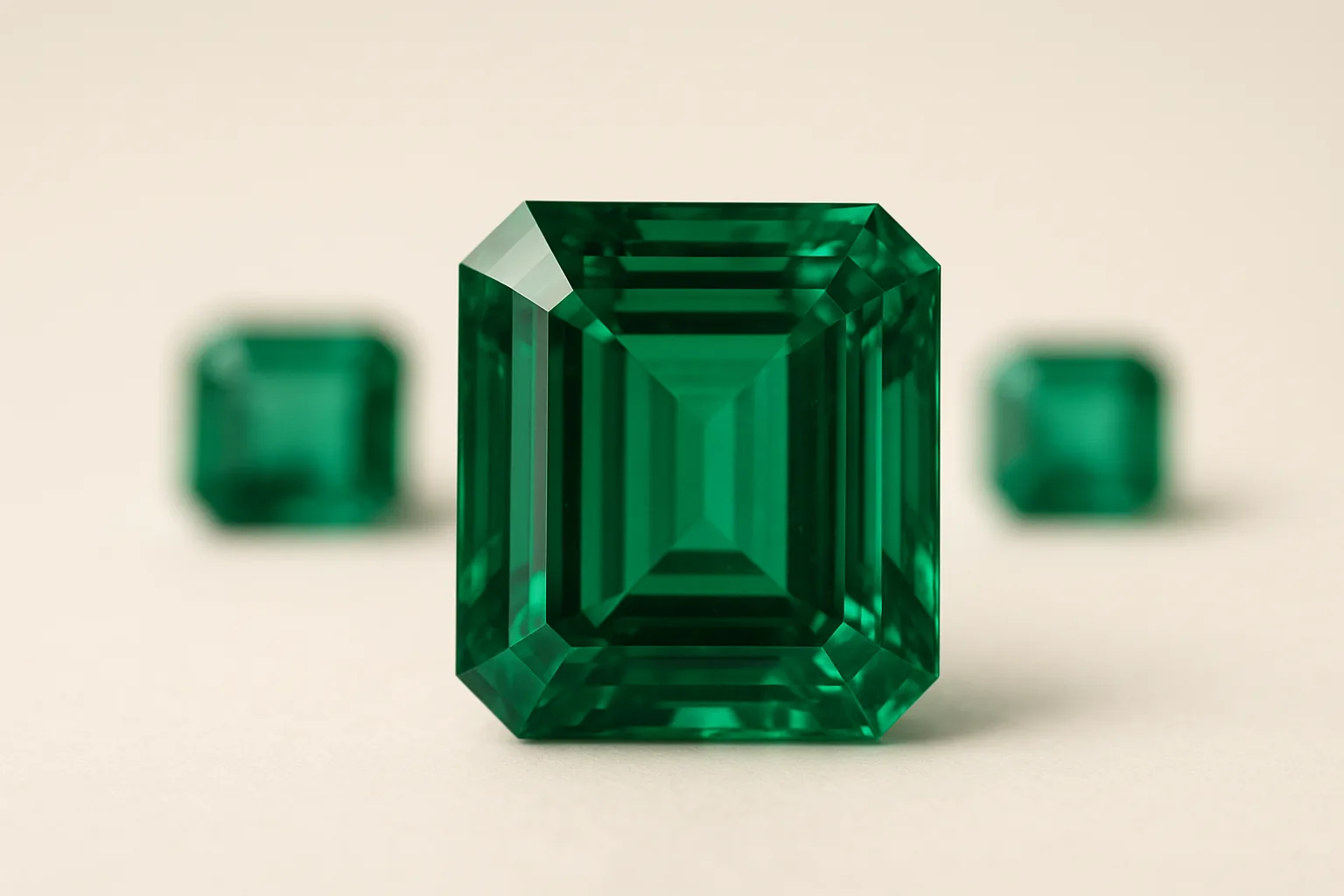
The origin of the name emerald
The stone was called smaragdos (green), and in Greek its name evolved into azmargad; by way of Old French and Middle English its name changed to emerald.
The emerald, known in Hebrew as bareket, is the birthstone of the month of May. The emerald comes in various shades of green, from a deep, dark green through to a soft green, a delicate grass green and a light green.
The shades of green are caused by the influence of the mineral chromium.
The emerald, which reflects the colors of spring, is the gemstone of the month of May, and it is also a traditional gift for those celebrating a 20th or 35th anniversary.
The emerald is a relatively strong gemstone, rated 7.5–8 on the Mohs scale of hardness, but although it is relatively durable it may break or scratch.
Emeralds are found in many countries, including Colombia, Russia and Brazil, which is the world's largest supplier of emeralds. Most emeralds come from Madagascar, Colombia and Zambia.
The green gemstone is mined at various sites around the world, but what is distinctive about it is that you can tell from its color and the nature of its inclusions which region of the world it came from.
The most valuable emeralds are those of a pure, brilliant green with a saturated, pure tone showing no trace of other colors such as brown or yellow; it is also extremely rare to find a natural emerald without flaws. Most emeralds contain inclusions (flaws), and therefore a high-quality natural emerald will sometimes be worth more than a high-quality diamond of the same weight.
The bareket in Judaism
The bareket is mentioned in the Bible several times, principally in the description of the breastplate - it is the third stone in the first row of the breastplate and is attributed to the tribe of Levi. There is admittedly no description of the stones, and so it is not known with certainty that this is the same stone; nevertheless, in Hebrew the identification of the biblical bareket with the emerald has taken root.
Midrash Talpiyot, the book of Rabbi Eliyahu HaKohen of the 17th–18th century, who lived in Izmir, Turkey, writes of the bareket that "Levi is inscribed upon bareket, and it is so called because it sparkles like lightning (barak) and shines like a candle, and Onkelos translated it barkan. And it is called ekdach, as it is said: 'and thy gates of carbuncle stones' (avnei ekdach), because it burns like an ember, and this is from the language of those who kindle fire; and it was given to Levi because the tribe of Levi gave light through the Torah, as it is said: 'They shall teach Thy ordinances'; and Moses, who was of the tribe of Levi, when he was born the house was filled with light, and the skin of his face shone, as it is said: 'A man's wisdom maketh his face to shine.' And its special virtue is that it makes the simple wise and gives light to the eyes, quite apart from the fact that its very substance is used as a lamp; and they say that if it is ground and mixed into food and drink it greatly helps to make one wise and to open the heart."
According to the commentary "Shiltei HaGiborim" by Rabbi Yehoshua Boaz ben Shimon Baruch, the bareket "makes the simple wise and gives light to the eyes in the Torah".
Emeralds are regarded as stones of enchantment and mystery, bearing the color of nature, which encourage a calm and tranquil spirit.
The emerald stone: virtues and properties
The bareket is considered a stone that relieves stress and brings physical, emotional and spiritual balance. The stone helps in times of change and assists in seeing new directions. It is also regarded as purifying negative energies, and according to Indian belief the bareket instils abundance, tranquillity, wellbeing and good fortune. On the physical side, the stone is considered helpful in treating problems of vision, breathing and the back.
Historical background on the bareket
The bareket is considered one of the most precious gemstones in nature. Its use is known as far back as ancient Egypt, where bareket stones were found among the objects of the embalmed. Egypt was the principal source of the stone in antiquity, and the stones mined there were traded in India and in Europe. The bareket's fame reached its height when the Spanish discovered magnificent stones in South America.
Legends about the bareket
Many fantastical stories have attached themselves to the bareket over the years. The Aztecs believed it was sacred; some believe that Hermes Trismegistus, who according to belief was a fusion of the Greek god of wisdom and magic, Hermes, with the Egyptian god Thoth, engraved laws of magic on a tablet of bareket known as the "Emerald Tablet". According to certain beliefs the Holy Grail is made of bareket.
Worth knowing: almost all natural emeralds undergo treatment to improve their color and remove visible flaws. It is customary in the industry to use a green-tinted oil to fill fissures and strengthen the emerald against accidental fractures or cracks.
Thanks to their intense green tone, emeralds are highly suited to luxury jewelry or to investment. Whether you are looking for a striking center stone or side stones, this is excellent value and elegance, with good durability alongside a rich color. Emeralds are a combination of sophistication and authenticity.
Alternative stones: green tourmaline.
Frequently asked questions
What is important to check when choosing emeralds? When buying unset emeralds (opens in new tab), it is important to pay attention to color (a deep, clean green without brown or yellow tones), clarity (although natural flaws are common, fewer visible flaws increases the value), cut (symmetry and polish affect the brilliance) and the origin of the stone.
What does "natural emerald" mean, and how does it differ from synthetic or treated stones? Natural emeralds are gemstones formed in nature and not in a laboratory. Most emeralds undergo accepted treatments (such as oil filling) to improve the color or reduce visible fissures. Synthetic emeralds are produced artificially and may be of lower value or rarity.
Why is color so important in an emerald, and which shades are considered the finest? Color is the most important characteristic in natural emeralds: the most valuable stones display an intense, saturated green with no brown or yellow tones. The range runs from a deep forest green to a light grass green.
What are the sources of the finest emeralds? Some of the best natural emeralds come from countries such as Colombia and Zambia. Colombian emeralds (opens in new tab) are known for their rich green tone, while emeralds from Zambia (opens in new tab) are regarded as having a bluish-green tone and a slightly stronger structure.
How durable are emeralds compared with other gemstones? Emeralds are rated approximately 7.5–8 on the Mohs scale, which makes them relatively durable, but they may still scratch or break more easily than harder stones such as diamonds or sapphires. It is advisable to handle them with care.
Are treatments on emeralds accepted when buying quality stones? Yes! Most natural emeralds undergo the accepted treatment of colorless oil to improve their appearance and brilliance. This is a common and accepted treatment in the industry; the seller is of course obliged to disclose the type and extent of the treatment.
How do you care for and clean an emerald or emerald jewelry? To preserve an emerald's beauty, avoid strong chemicals, ultrasonic cleaning or steam. Clean gently with lukewarm water, mild soap and a soft cloth. It is advisable to remove emerald jewelry during strenuous activity.
Are emeralds suitable for engagement rings or everyday wear? Yes! Many natural emeralds are suitable for emerald engagement rings (opens in new tab) or fine jewelry. That said, because of their relative sensitivity, it is advisable to choose a protective setting and to carry out periodic maintenance in order to preserve the brilliance.
Why do some emeralds cost more even at the same carat weight? Beyond weight, the value of emeralds is determined by the intensity of the color, the clarity (how few visible flaws there are), the quality of the cut, the origin of the stone and the treatments. A small stone with a particularly intense green color and fewer treatments may be more expensive than a large, paler or more heavily treated stone.
What certificate or assurance should you ask for when buying natural emeralds? For peace of mind, it is advisable to buy from a recognized and reliable supplier who provides a guarantee of the stone's origin and quality, who works only with first-rate suppliers and laboratories, and who ensures that your emerald will be unique, of high quality and timeless. Because an emerald's value depends so much on color, clarity and the treatment it has received, many buyers prefer to purchase closer to the source - from a specialist or direct supplier such as Israel Diamonds rather than through several intermediaries - which makes it easier to compare certified loose emeralds (opens in new tab) on documented, transparent terms.
Emerald is the birthstone for May, and the May birthstone guide sets out what tradition has attached to it.