Alexandrite
Alexandrite reads green in daylight and red under a lamp. A guide to judging the change, the three things sold under the name, and what each one costs.
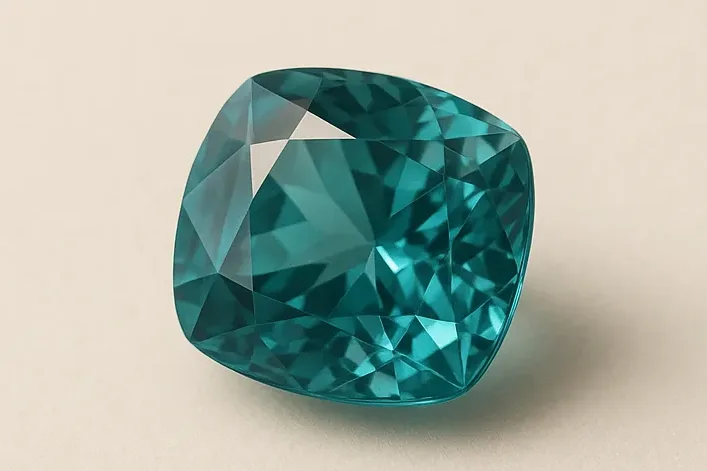
Alexandrite is the gem that changes color. In daylight it reads green, from a soft sage to a saturated blue green. Under a lamp or a candle it turns raspberry, purple or a warm red. It is the same stone, unaltered, responding to whatever you light it with.
It is also one of the rarest gems in commercial trade, and one of the most expensive by weight. Fine alexandrite over a carat can cost more per carat than an equivalent ruby or emerald. Most of what is sold under the name is not alexandrite at all.
This page explains what drives the price, how to tell a strong color change from a weak one, where the stones come from now that the Russian mines are finished, and how to read a listing so you know which of the three different things called alexandrite you are being offered.
The color change, and what makes it good
The effect comes from chromium sitting in the chrysoberyl structure. Chromium absorbs light in the yellow band, leaving the eye a near balance of green and red. Daylight is rich in blue and green, so green wins. Incandescent light is rich in red, so red wins. Fluorescent and LED lighting sit between the two and can make a stone look muddy, which is worth knowing before you judge one under an office ceiling.
Two stones can both change color and be worth ten times different amounts. Three things separate them:
- How complete the change is. Usually quoted as a percentage. A stone described as a 100 per cent change goes fully from one color to the other with nothing left of the first. Below roughly 50 per cent the change reads as a shift in tone rather than a change of color, and the price falls sharply.
- What the two colors actually are. Green to red is the classic and the most valuable. Many stones run from a grayish olive to a brownish purple, which is technically a change and visually a disappointment.
- How saturated each color is. A pale mint that becomes a pale mauve is a weak stone even with a complete change. Depth of color in both states is what commands the money.
Sellers photograph alexandrite under two lights for exactly this reason, and a listing that shows only one state is hiding half the stone. Ask for both, shot in the same session against the same background.
Where alexandrite comes from
The stone was found in the Ural Mountains in the 1830s and named for the future Tsar Alexander II. Russian material set the standard: a strong green to a deep red, in small sizes. Those deposits were worked out long ago, and genuine Russian alexandrite now appears mostly through estate sales, at prices reflecting provenance as much as quality.
Current production is thin and scattered:
- Brazil. The Hematita deposit in Minas Gerais produced fine material from the late 1980s, some of it rivalling Russian color. Output has fallen a long way since.
- Sri Lanka. Larger stones, often with a change running more towards khaki and brownish red than green to raspberry. Cat's eye alexandrite comes mainly from here.
- Tanzania and Madagascar. Newer sources, variable, occasionally very good.
- India. Small stones, generally lower saturation.
Origin affects price but is not a proxy for quality. A superb Brazilian stone beats a mediocre Russian one, whatever the report says about where it grew.
Hardness and everyday durability
Alexandrite is chrysoberyl, 8.5 on the Mohs scale. Among stones you will meet in jewelry, only corundum and diamond are harder. Just as importantly it has no easy cleavage direction, which is where topaz and emerald get into trouble, and its toughness is rated excellent.
That makes it one of the few colored stones genuinely suited to daily wear on a hand. It resists scratching, survives knocks, and does not need a protective setting to be safe. If you want a colored stone in an engagement ring and durability is the deciding factor, alexandrite and sapphire are the two that ask least of you. Our guide to settings covers how that widens the design options open to you.
Natural, lab-grown, and the stones that are neither
Three different things are sold as alexandrite, and the price gap between them is enormous.
- Natural alexandrite. Grown in the ground, color change from chromium. Rare, expensive, and always worth a report from an independent laboratory above a few hundred dollars.
- Lab-grown alexandrite. Real chrysoberyl with the same chemistry and the same color change, produced by the Czochralski pull or by flux growth. A legitimate product sold honestly at a small fraction of natural prices. It is not a fake. It is a different thing, and it has to be disclosed.
- Color-change synthetic sapphire. This is the one to watch. It is corundum doped with vanadium, it shifts from a grayish blue to a purple, and it has been sold as alexandrite for over a century. It is neither natural nor chrysoberyl. If a listing offers a large alexandrite cheaply and the change runs blue to purple rather than green to red, this is almost certainly what it is.
Several other stones show a genuine alexandrite effect and are sold honestly under their own names: color-change garnet, color-change sapphire, some spinel and some fluorite. Those are collectable in their own right. The problem is only ever the label.
What separates a good alexandrite from a great one
Color change
The dominant value factor, ahead of everything else. Ask for the percentage of change and for photographs in both lights. A complete change from a saturated green to a saturated red is what the top prices buy.
The two colors
Look for green rather than olive or khaki in daylight, and red or raspberry rather than brown or muddy purple under a lamp. Gray is the enemy in both states.
Clarity
Alexandrite is usually included and the market accepts that. Eye-clean stones exist and cost more, but an inclusion that does not interrupt the color is no reason to reject a stone with a strong change. Judge clarity after color, never before it. The same logic applies as on our diamond clarity page, with the difference that here color outranks it by a wider margin.
Cut
Cutters orient alexandrite to maximise the change, which sometimes means accepting a less symmetrical outline or a deeper stone. A slightly heavy cut giving a full color change beats a pretty one giving a partial one.
Carat weight
Fine alexandrite above one carat is genuinely scarce, and price per carat climbs in steps rather than smoothly. Above three carats, fine natural stones are collector material and priced accordingly.
What loose alexandrite costs
Prices vary more than in almost any other gem, because the color change resists being reduced to a grade. As a broad orientation for natural material, in dollars per carat:
| Quality of change | Under 1 ct | 1 to 2 ct | Over 2 ct |
|---|---|---|---|
| Weak change, grayish colors | $500 - $1,500 | $1,500 - $4,000 | $4,000 - $8,000 |
| Moderate change, good colors | $2,000 - $5,000 | $5,000 - $12,000 | $12,000 - $25,000 |
| Strong change, saturated green to red | $5,000 - $10,000 | $12,000 - $30,000 | $30,000 and up |
Lab-grown alexandrite of good color typically runs from tens to low hundreds of dollars per carat at any size, which is the honest choice if you want the effect rather than the rarity.
Treat every figure above as the start of a conversation rather than a quote. Two natural stones of the same weight can differ by a factor of ten on the strength of the change alone.
Meaning, symbolism and the June birthstone
Alexandrite is one of three birthstones for June, alongside pearl and moonstone. It is much the newest of the three, added in the twentieth century, and it is the only one of them hard enough for a ring worn every day. The June birthstone page compares all three.
Because it was found in Russia and named for a Tsar, the stone carried imperial associations from the start, and its green and red were read as the colors of the imperial military. Later traditions attach it to balance, adaptability and self-knowledge, on the obvious metaphor of a thing that shows a different face depending on where it stands. It is also the gem given for a fifty-fifth wedding anniversary.
If you are choosing a stone by birth month rather than by eye, our astrology and gemstones guide sets out how the zodiac traditions map onto stones. That is a different scheme from the birthstone calendar and it often gives a different answer.
Why buy the stone loose
Alexandrite is the strongest case in this whole series for buying the stone before the setting, for reasons specific to it:
- The change can only be judged loose. Once the stone is set, the metal reflects into it and the mounting shades it. Photographs of a mounted stone under two lights tell you much less.
- One variable dominates the price. With most gems you trade color against clarity against size. Here the change outweighs everything, so seeing it properly before committing is worth more than it would be elsewhere.
- Sizes are unpredictable. You cannot order a 1.25 carat fine alexandrite the way you can order a 1.25 carat sapphire. You find a stone and design around it, not the other way round.
Once you have the stone, designing a ring around it (opens in new tab) is the straightforward part.
Designing around a loose alexandrite
A few things follow from the color change that would not apply to a single-color stone:
- Metal choice matters more than usual. White metals stay neutral and let both states read cleanly. Yellow gold warms the daylight green towards olive. Rose gold flatters the lamp-lit red and fights the green. Our metals guide covers the trade-offs; with alexandrite the honest default is platinum or white gold.
- Keep the stone open underneath. An open setting lets light through and the change show. A closed back mutes it.
- Be careful with colored accents. Diamonds are safe. A colored accent will agree with one state of the alexandrite and argue with the other.
- Do not over-protect it. At 8.5 with excellent toughness it does not need a bezel for safety, and a bezel costs you light. Prongs are fine.
A short buying checklist
- Ask for photographs in daylight and under incandescent light, taken in the same session.
- Ask for the percentage of color change in writing.
- Above a few hundred dollars, ask for a report from an independent laboratory stating natural or laboratory-grown, and species chrysoberyl.
- Check the change runs green to red, not blue to purple. Blue to purple usually means synthetic sapphire.
- Confirm whether the price quoted is per carat or for the whole stone.
- Ask what the stone looks like under LED, since that is the light most rooms actually have.
Frequently asked questions
Is alexandrite more expensive than diamond? Fine natural alexandrite above one carat usually is, per carat. Below that, and in weaker color change, it is often less. The comparison depends entirely on quality at both ends.
Why is most alexandrite so small? The deposits yield very little rough of fine color, and cutters lose weight orienting the stone for the change. Fine stones above two carats are unusual enough to be individually notable.
Is lab-grown alexandrite real alexandrite? Chemically and optically, yes: it is chrysoberyl with the same color change. It is not rare, and its price reflects that. It has to be disclosed as laboratory-grown.
What is the difference between alexandrite and color-change sapphire? Different minerals. Alexandrite is chrysoberyl and typically changes green to red. Color-change sapphire is corundum and typically changes blue to purple. Both are legitimate stones. Only one of them is alexandrite.
Can I wear alexandrite every day? Yes. At 8.5 on the Mohs scale, with no cleavage and excellent toughness, it is one of the better colored stones for daily wear.
Does the color change fade over time? No. It is a property of the stone's chemistry rather than a treatment, and it does not weaken.
Is alexandrite ever treated? Rarely. There is no established treatment that creates or improves the color change, which is part of why fine material stays expensive. Some stones are clarity-enhanced with fracture filling, which should be disclosed.
Can I judge the change from a photograph? Not reliably. Images can be white-balanced to exaggerate the difference. Ask for both shots taken together, and for video under a changing light if the price justifies it.
If you are weighing alexandrite against the other colored stones, the semi-precious stones guide compares the series side by side, and we are happy to answer questions directly (opens in new tab).