Tiger's Eye
A few dollars a carat, and often priced as if it were not. How the fibre bands form, how to spot dye, and how it differs from cat's eye chrysoberyl.
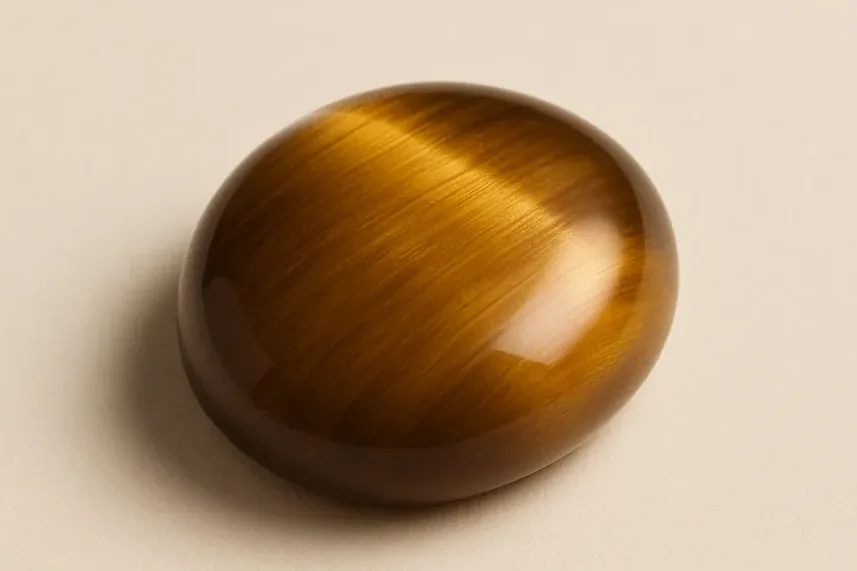
Tiger's eye is the most affordable stone in this series and one of the most recognisable: a warm golden brown crossed by silky bands of light that shift as the stone moves, like watered silk or a bundle of fine fibres under the polish. It costs a few dollars, it is hard enough to wear, and it is genuinely handsome.
It is also the stone most often confused with something a hundred times its price. Cat's eye chrysoberyl shows one sharp line of light on a golden body; tiger's eye shows a broad silky shimmer across the whole surface. The names are similar, the appearance is not, and the price gap is enormous.
This page covers what produces the banding, the varieties including the blue and red ones, how to tell natural material from dyed, what it costs, and the durability picture, which is better than most stones at this price.
What produces the bands
Tiger's eye is quartz that formed alongside, and largely replaced, fibrous crocidolite. The parallel fibre structure survives the replacement, and light reflecting off all those aligned fibres returns as a broad silky sheen running at right angles to them. The trade calls the effect chatoyancy, the same word used for cat's eye.
The traditional explanation was that quartz slowly pseudomorphed the crocidolite fibre by fibre. More recent work argues the two grew together in a crack-seal process as the vein repeatedly opened and refilled, which better explains the way the fibres bend and match across the bands. Either way the practical result is the same: aligned fibres, and a sheen that moves.
The difference from cat's eye chrysoberyl is worth being precise about. There the inclusions are sparse needles in a transparent stone and the reflection concentrates into a single narrow line. Here the fibres make up the entire body of an opaque stone, so the reflection is spread across the whole surface as a broad shimmer. Our cat's eye guide covers the expensive one.
The varieties
| Name | What it is | Colour |
|---|---|---|
| Tiger's eye | The common material, iron oxidised to limonite | Golden brown to honey with gold bands |
| Hawk's eye | Less altered, the original crocidolite colour retained | Blue grey to slate blue |
| Red tiger's eye | Usually heat treated, occasionally natural | Deep reddish brown |
| Tiger iron | Tiger's eye banded with hematite and red jasper | Gold, red and metallic grey layers |
Hawk's eye is the same material caught earlier in the alteration process, before the iron oxidised from blue-grey to golden brown, and stones showing both colours in one piece are common and often the most interesting. Red tiger's eye is nearly always produced by gentle heating, which is stable, undetectable and universally accepted at this price point.
Judging it, and spotting dye
Value at this level is driven by the quality of the sheen rather than by rarity:
| Factor | What to look for |
|---|---|
| Band strength | A bright, clearly defined shimmer that rolls as the stone tilts |
| Fibre alignment | Straight parallel fibres; wavy or interrupted fibre spoils the roll |
| Orientation | Cut so the bands run across the stone, not diagonally off a corner |
| Colour depth | A rich honey gold rather than a flat dull brown |
| Polish | A smooth high polish, since a dull surface kills the sheen entirely |
Dyed material is common, especially in blues, greens, reds and purples that do not occur naturally in this stone. Any tiger's eye in a colour outside the golden brown, blue grey and red range has been dyed, without exception. Look for colour pooling in cracks and for an unnaturally even, saturated tone; a cotton bud with a little acetone on an inconspicuous spot will often lift dye, though not on a piece you do not yet own.
Where it comes from
The Northern Cape province of South Africa, principally around Griquatown, has been the dominant source for well over a century and supplies most of the world market. Western Australia produces the tiger iron variety, and Namibia, India, Brazil and Myanmar all contribute smaller quantities.
Origin has no effect on price here. This is a commodity material sold by the kilogram at the rough stage, and nobody pays a premium for a country.
Hardness and everyday wear
Tiger's eye is quartz, so it sits at 7 on the Mohs scale with no cleavage and good toughness. That makes it considerably more durable than opal, moonstone, turquoise or tanzanite, and perfectly practical for a ring worn daily. For a stone that costs a few dollars a carat, that is a genuinely good deal.
The one real caution is that the fibrous structure can be undercut by aggressive polishing or by long wear, leaving the surface slightly ridged and dulling the sheen. It can be repolished cheaply. Our guide to settings covers mounting options, and as a cabochon it takes a bezel naturally.
What it costs
Very little, and it is worth being blunt about that because inflated pricing on tiger's eye is common in the crystal and wellness market:
| Form | Typical price |
|---|---|
| Tumbled stones and beads | Cents to a few dollars each |
| Ordinary cabochons | $1 - $3 per carat |
| Fine cabochons, strong sharp banding | $3 - $10 per carat |
| Exceptional hawk's eye or tiger iron pieces | $10 - $25 per carat |
If you are quoted hundreds of dollars per carat for tiger's eye, either the stone is not tiger's eye or the price is not related to the material. This is the clearest case in this series where knowing the going rate is the entire protection you need.
Meaning and symbolism
Tiger's eye is not a modern birthstone for any month, though older lists occasionally attached it to the sign of Leo, and our astrology and gemstones guide explains how those older systems worked and where they disagree with the calendar.
The traditional associations are courage, focus and grounded confidence, and Roman soldiers are said to have carried it into battle. As with all such traditions the evidence is thin and the association is worth exactly what you want it to be worth, but it is at least consistent: nobody has ever claimed tiger's eye was a stone of passivity.
Designing around tiger's eye
- Get the bands running across the finger. As with any chatoyant stone, orientation decides whether the sheen reads from the wearer's viewpoint or only from the side.
- A bezel suits it, as it does any cabochon without a girdle for prongs to grip. Our settings guide shows the options.
- Yellow gold is the obvious partner for the golden brown, and it is hard to improve on. Our metals guide covers the alternatives if you want a cooler contrast.
- Spend on the cut, not the stone. Since the material costs almost nothing, the whole quality difference lies in polish, orientation and symmetry.
- Use it at scale. Because it is cheap and durable, tiger's eye is one of the few stones where a large bold piece is entirely affordable.
A short buying checklist
- Ask for video with the stone tilting, since the sheen is a moving effect.
- Check the bands are straight, bright and run across the stone rather than off a corner.
- Treat any colour outside golden brown, blue grey and red as dyed.
- Look for dye pooling along cracks and around the girdle.
- Check the polish is high and even, because a poor polish destroys the effect.
- Compare against the going rate above before agreeing any price.
Frequently asked questions
Is tiger's eye the same as cat's eye? No. Cat's eye chrysoberyl shows one sharp line of light on a transparent golden body and is a fine gem. Tiger's eye shows a broad silky sheen across an opaque brown stone and costs a few dollars.
Is tiger's eye dangerous because of asbestos? Crocidolite is a form of asbestos, but in tiger's eye it has been replaced by or intergrown with quartz and is locked in a solid mass. Finished polished stones present no meaningful risk. Cutting and grinding the rough without dust control is a different matter.
Is red tiger's eye natural? Usually not. It is typically produced by gentle heating, which is stable and permanent. Natural red material exists but is uncommon.
Why is blue tiger's eye sometimes cheap and sometimes not? Natural hawk's eye is genuinely blue grey and modestly priced. Bright electric blue material is dyed and worth less again.
Is it hard enough for daily wear? Yes. At 7 with no cleavage it is one of the more durable stones in this series, and by a wide margin the most durable one at its price.
Does tiger's eye fade? The sheen does not fade, but dyed material can, and long wear can dull the polish. A repolish restores it inexpensively.
Why does mine look dull? Almost always polish rather than material. A worn or poorly finished surface scatters the light that should be forming the bands.
How do I clean it? Warm water, mild soap and a soft brush. It is quartz and tolerates this well; avoid prolonged soaking if the piece is dyed.
To see how it sits against the rest of the coloured stones, the semi-precious stones guide compares the series side by side, and we are happy to answer questions directly (opens in new tab).