How to Save Money Buying a Diamond Without Sacrificing Beauty
Carat is weight, not size. Learn which grades you can ease off without it showing, which one you must never touch, and how to buy the diamond you see.
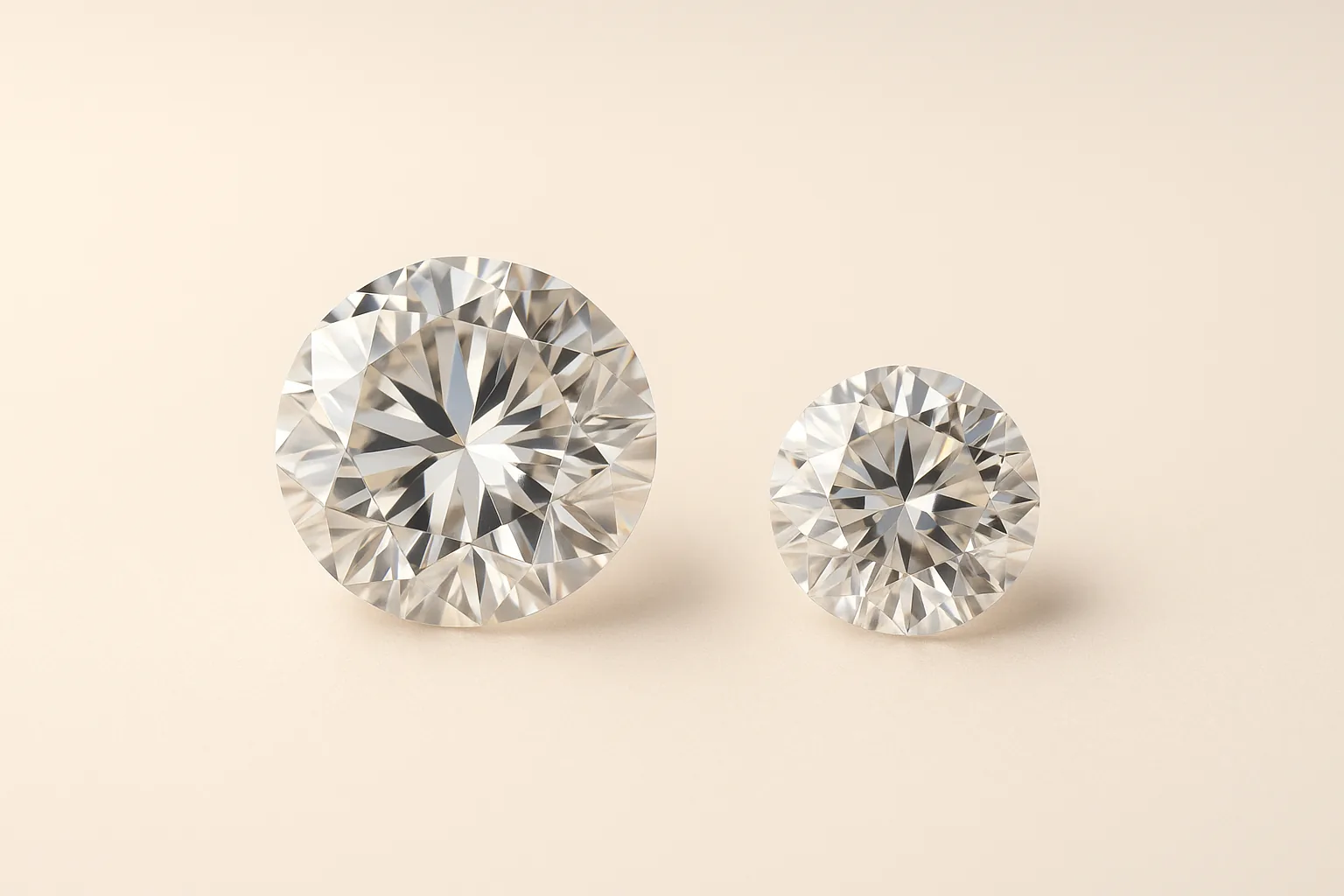
A smaller budget does not have to mean a lesser ring. It means paying for what you can see and refusing to pay for what you cannot. Two natural diamonds of the same weight can differ by half again in price and look identical across a dinner table, because the difference sits in grades nobody can read without a loupe. This page is about finding that difference and keeping it.
Carat weight is not diamond size
Almost everyone uses carat as a synonym for size. It is not one. A carat is a unit of weight, one fifth of a gram, and it describes what a diamond weighs rather than how large it looks. Two stones of identical carat weight can look plainly different once they are set.
What you see on a hand is face-up size: the width of the stone as it looks up at you, measured in millimeters. Every GIA report prints it, listed as the measurements, and for a buyer it is the most useful line on the page. A diamond can carry its weight down in a deep pavilion, where it does nothing for the eye, or spread it across the top where it shows. Weight hidden underneath is weight you paid for and nobody will ever see.
- Read the measurements, not only the weight. On a round brilliant the first two figures are the diameter across the girdle. Those millimeters are what sits above the setting and what people actually notice.
- Compare candidates in millimeters. Two stones described as the same weight can differ by a quarter of a millimeter or more across the top. Listed on paper they look equal. On a finger they do not.
- Treat depth as a warning sign. A stone much deeper than it is wide is carrying weight below the girdle. It weighs more, costs more, and looks smaller than a shallower, better proportioned diamond of the same weight.
Carat weight explains the scale in full, including why prices step rather than climb.
Avoid the one-carat price jump
Diamond prices do not rise smoothly with weight. They step. The steps sit at the round numbers, at half a carat, at three quarters, and above all at one full carat, because that is where demand gathers. Buyers ask for a one-carat diamond by name, and the market charges for the name as much as for the stone.
A diamond of 0.95 to 0.99 carat sits just under that line. Across the top it is a fraction of a millimeter narrower than a full carat, a difference nobody has ever noticed on a hand, and it is priced in the band below. The same holds just under half a carat and just under three quarters.
- Ask to see stones just below a milestone. Many sellers will not show them unless you ask, because the round numbers sell themselves.
- Judge the pair face up, not on paper. Put a 0.97 beside a 1.00 of the same cut grade and look at them from above at arm’s length. If you can tell which is which, buy the larger one. Most people cannot.
Cut matters more than weight
Cut is the only one of the four Cs made by a person rather than found in the ground. It is also the one that decides whether a diamond returns light to your eye or sits flat and gray on the hand. Color and clarity grades describe the raw material; the cut grade describes the work done to it.
Cut also changes apparent size. A well cut stone spreads its weight across the top and pulls light back up through the table, so it reads both brighter and wider. An Excellent cut diamond a little under a carat can measure as wide across the top as a poorly cut full carat, and it will look better lit while doing it. That is the argument of this page in one sentence: the same money buys either a number or a diamond.
That is why cut is the one place not to economize. A badly cut diamond of high color and clarity looks worse than a well cut stone several grades below it on both. If the budget forces the choice, take the smaller, slightly warmer, slightly less clean stone that is cut well. Cut explains what the grades measure.
Watch this short video to learn how to save money when buying a diamond.
Grades you can ease off without it showing
Choose an eye-clean SI1
Clarity grades describe what a trained grader sees at ten times magnification under controlled light. They do not describe what you see. SI1 means small inclusions, and on a great many SI1 stones those inclusions cannot be found at all with the naked eye.
A diamond like that is called eye-clean. At normal viewing distance it looks the same as a VS or VVS stone of the same cut and color, and it costs a great deal less. The grade is a record of what is present, not a verdict on how the stone looks.
The catch is that SI1 is a range rather than a promise, so the stone has to be judged one at a time.
- Ask whether the stone is eye-clean, and ask in writing. That is a statement about the particular diamond rather than about its grade, and a seller who knows the stone can answer plainly.
- Where the inclusion sits matters more than its size. Something near the girdle or under a prong disappears. The same feature dead center under the table does not.
- Dark and light read differently. A small white feather is easy to miss. A black crystal of the same size in the same place is not.
Diamond clarity sets out the whole scale and what each grade allows.
G color is the value grade
GIA is the strictest of the major grading laboratories, and a color grade from GIA can be relied on to mean what it says. That strictness is exactly what makes its middle grades such good value: a stone GIA calls G would be graded higher by several other laboratories.
G sits in the near-colorless band, three grades below the top of the scale. Face up, in a setting, in ordinary light, it reads white. The difference between D and G is real, but it is subtle, and it usually shows only when loose stones are laid side by side, table down, on a white background, under controlled lighting. That is how a grader sees diamonds. It is not how anyone will see yours.
Warm metal helps further. In yellow or rose gold the setting lends the stone some of its own color, and a grade or two of warmth stops being visible at all. Diamond color shows where the visible line actually falls, and GIA certification explains what a report tells you and what it leaves out.
Where else to give ground
Three smaller levers, and one that is different in kind.
- Do not fear faint fluorescence. A stone that glows slightly under ultraviolet light often sells for less than an identical one that does not, and in ordinary light the difference is usually invisible. In a warmer stone it can even help it face up whiter. Fluorescence covers when it matters and when it does not.
- Look past the round brilliant. It is the most in demand and the most wasteful shape to cut, so it costs the most per carat. Oval, pear, cushion and emerald cuts of the same weight generally cost less - and the elongated shapes read larger for their weight, because they spread further along the finger.
- Consider a lab-grown stone. Last here because it is different in kind from everything above: not a grade eased off, but a different stone. It is also the largest lever of all, and not a compromise on quality - a laboratory diamond is the same material, graded on the same scales by the same laboratories. What you give up is rarity, and with it most of the resale value. Natural or lab-grown sets out the trade honestly.
What the setting can do
The mount changes how large a stone reads. A halo of small stones around the centre adds visual size for a fraction of what that weight would cost in the centre stone itself. A slim band makes the stone above it look wider by contrast. None of this is trickery - it is how jewellers have always made a modest stone look its best. Setting a budget covers how to split the total between the stone and the ring around it.
Spend on what you can see
Put the levers together and the shape of a good decision appears. Stepping just under a round weight, taking an eye-clean SI1 rather than a VVS, and choosing G rather than D are three separate savings, and not one of them is visible on a hand. Cut is the one that is visible, every time the light moves. Choosing a diamond covers all four in order.
So buy the cut, and spend the savings on it. Two people can pay the same and end up with very different rings: one wearing a full carat, D, Flawless, cut to keep weight rather than to return light; the other wearing a slightly smaller G, SI1, cut as well as it can be. Across a table, the second ring is the one people notice.
One last thing, and it is where a small budget differs most. For the centre stone, get an independent grading report and treat that as settled - it is what separates a grade from somebody's word about a grade. Small stones are another matter. The melee set into a halo or along a band is almost never certified one by one, because a report can cost a real share of what such a stone is worth, and the same is often true of a modest centre stone. What protects you there is who you are buying from rather than what is on paper: a dealer belonging to a diamond exchange is bound by its rules and its arbitration, which is an assurance of a different kind. Israel Diamonds (opens in new tab) is a member. GIA certification explains what a report tells you and what it leaves out.
Frequently asked questions
Does a higher carat weight always mean a bigger-looking diamond? No. Carat is weight, not width. A deep, poorly proportioned stone carries weight below the girdle where it cannot be seen, so it can look smaller face up than a lighter, better cut diamond. Compare the millimeter measurements on the report rather than the weight alone.
Is a 0.95 carat diamond noticeably smaller than a 1.00 carat? Not to the eye. The difference across the top of a round brilliant is a fraction of a millimeter, while the price sits in a lower band because demand clusters at the round number. It is the simplest saving available to a buyer who wants visible size.
Is an SI1 diamond a good choice? Often yes, provided that particular stone is eye-clean. SI1 covers a wide range, so it has to be judged stone by stone rather than bought on the grade. An eye-clean SI1 looks the same as a VS diamond at normal viewing distance and costs considerably less.
Is G color noticeably different from D? Rarely, once the stone is set. Both sit in the range most people read as white. The difference generally shows only when loose stones are compared side by side against a white background under controlled light, and a yellow or rose gold setting conceals it entirely.
What are the measurements on a GIA report? They are the stone’s physical dimensions in millimeters. On a round brilliant they read as minimum diameter, maximum diameter and depth. The first two determine how large the diamond looks from above, which is why they matter more to a buyer than the carat figure alone.
Does a smaller diamond need a GIA report? For a center stone of any real size, yes. Below that, small accent stones are almost never certified individually, because a report would cost a meaningful share of what the stone is worth. There, the standing of the seller is what stands in for the paperwork.
Looking at stones
Reading about diamonds only takes you so far. At some point you need to see two stones side by side and decide which one you prefer, which teaches more in a minute than any article. Browse the natural diamond inventory (opens in new tab) at Israel Diamonds, or design a ring around a stone you have chosen (opens in new tab). If you would rather describe your budget and let someone else do the searching, write to CustomerService@Israel-Diamonds.com and ask for the best value they can find within it. There is no charge for asking, and the answer should be a shortlist rather than a sales pitch.
The stone is only part of the figure, and the band, the setting and the metal carry the rest; the guide to the ring itself covers what the ring itself adds.
Where should your money go?
Choosing where to allocate your budget for an engagement ring can be a significant decision. Our quiz is here to guide you based on what truly matters most to you.
Question 1 of 5