Tanzanite
Found in one four-kilometre strip of Tanzania. Why nearly all of it is heated, how to judge the violetish blue, and what AAA grades actually mean.
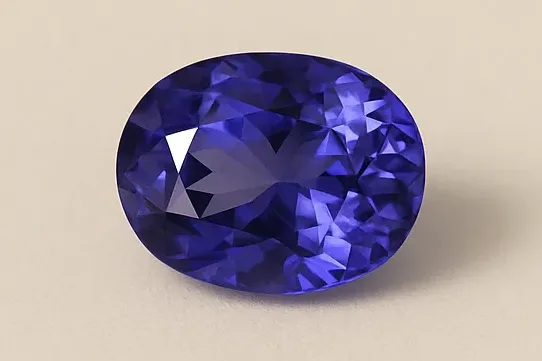
Tanzanite comes from one place. Not one country, one region: a strip of hills at Merelani in northern Tanzania roughly four kilometres wide, and nowhere else on earth. Every tanzanite ever sold has come out of that ground, which makes it around a thousand times rarer than diamond by any sensible measure of supply.
It is also a young stone commercially. It was identified in 1967 and named by Tiffany, who declined to sell it as blue zoisite on the reasonable grounds that the word sounded like a medical condition. Within a few decades it went from unknown to one of the most recognised coloured stones in the world, and in 2002 it was added to the December birthstone list.
This page covers the colour and why almost every stone is heated, how to judge a good blue from a mediocre one, the cleavage problem that decides how it should be set, what it costs, and what the supply situation actually means for a buyer.
The colour, and what heat does
Tanzanite is a variety of zoisite, and it is strongly trichroic: it shows three different colours down three different crystal directions. In rough, untreated material those are typically blue, violet, and a muddy brownish yellow. The brown is the problem, and heat is the answer.
Heating to around 600 degrees Celsius removes the brown axis and leaves blue and violet. It is a permanent, stable change, it is undetectable in the finished stone, and it is applied to virtually all commercial tanzanite. Unheated material with a good blue exists but is genuinely rare, and a seller advertising unheated tanzanite should be asked for a laboratory report rather than taken at their word.
The consequence for a buyer is that heat treatment carries no stigma here and no price penalty, unlike in sapphire or ruby. Assume any tanzanite you are shown has been heated. It is the normal state of the material, not a compromise.
Judging the blue
Because the stone is trichroic, the cutter chooses which colour dominates by choosing the orientation. Cut for maximum blue and you waste more rough; cut for violet and you keep more weight. That decision, made before the stone was ever polished, drives most of what you are looking at:
| Factor | What to look for |
|---|---|
| Hue | Blue with violet flashes is the top of the market; violet with blue in it sits below |
| Saturation | Deep and vivid rather than pale and washed out, which is the single biggest price driver |
| Tone | Dark enough to be rich, light enough that it does not go inky and close up under indoor light |
| Windowing | Tilt it: a pale flat patch through the middle means the stone was cut shallow to save weight |
| Clarity | Eye-clean is the normal expectation here, unlike emerald, and inclusions are penalised |
Saturation is where the money goes. Small tanzanites are frequently pale, because saturation in this material rises with size and a one carat stone simply has less depth for the colour to build in. A vivid two carat stone can cost several times a washed-out one of the same weight, and this is the single most useful thing to understand before comparing prices.
The lighting trap
Tanzanite looks different under different light in a way few stones do. Under incandescent and most warm indoor lighting it shifts noticeably towards violet and purple; under daylight and cool white LED it reads bluer. Jewellery shops are lit with warm light, and warm light is flattering here.
Ask to see it by a window, or ask for video shot in daylight as well as indoors. Neither appearance is the real one and neither is deceptive, but you should know both before buying, because you will be living with whichever your home lighting produces.
Hardness, cleavage and everyday wear
Tanzanite is 6 to 7 on the Mohs scale, which is already below the threshold where dust stops scratching a stone. That is not the main issue. The main issue is that it has one direction of perfect cleavage, meaning a sharp knock along the wrong plane can split it cleanly rather than chip it.
It is also sensitive to sudden temperature change and should never go near an ultrasonic cleaner or a steam cleaner, both of which are standard equipment in a jeweller's workshop. Tell any jeweller working on the ring that the stone is tanzanite, before they clean it rather than after.
None of this rules it out as a ring stone, but it does argue strongly for a protective mounting. Our guide to settings covers the choices; a bezel or a halo that shields the girdle is the sensible instinct, and a high four-prong solitaire with the corners exposed is the one to avoid.
Where it comes from, and what happens next
The Merelani hills, and only there. The deposit is divided into blocks, with one of them worked mechanically at scale and the others by small-scale and artisanal miners. Production is genuinely finite and there is no second locality waiting to be found, because the geology that produced it was a specific and unusual event.
Predictions of imminent exhaustion have been made repeatedly since the 1980s and have repeatedly been wrong, so treat any sales pitch built on scarcity urgency with the scepticism it deserves. What is fair to say is that supply is constrained, that fine large stones are already difficult to source, and that the stone is not going to become more common.
What it costs
Driven by saturation first and size second, with the two connected because bigger stones hold deeper colour. As a broad orientation, in dollars per carat:
| Quality | Under 2 ct | 2 to 5 ct | Over 5 ct |
|---|---|---|---|
| Pale, greyish or washed out, visible window | $50 - $150 | $100 - $250 | $200 - $400 |
| Good violetish blue, eye-clean, well cut | $200 - $450 | $400 - $800 | $700 - $1,400 |
| Vivid deep blue with violet flash, top cut | $500 - $900 | $900 - $2,000 | $2,000 - $5,000 |
Trade grades such as AAA and AAAA appear constantly in tanzanite listings and mean nothing consistent. There is no governing body behind them and no shared definition, so one seller's AAA is another's A. Judge the stone, or judge a laboratory report; do not judge the letters.
Meaning and symbolism
Tanzanite is too young to carry deep tradition, which is worth saying plainly rather than inventing one. It joined the December birthstone list in 2002, alongside turquoise and zircon, and the December page covers the three together.
What has grown up around it instead is a set of associations with transformation and with clear communication, and a strong link to the Maasai, in whose lands it is found and for whom deep blue is a colour of sacredness. Some of that is genuine local significance and some is marketing built on top of it, and it is usually not difficult to tell which is which.
Designing around a tanzanite
- Protect the girdle. The cleavage direction makes an unguarded edge the weak point. A bezel or a halo earns its place here more than it does on most stones.
- Buy the colour, not the carat. A vivid smaller stone beats a pale larger one on both looks and resale, and the price gap runs the other way from what people expect.
- White metal keeps it blue. Yellow gold pushes the perceived colour towards violet. Both work, but the choice changes the stone; our metals guide covers it.
- Tell the setter what it is. Standard workshop cleaning will damage this stone, and the moment to prevent that is before the ring is handed over.
- Look at it in daylight before deciding. The showroom is the one lighting condition you will never wear it in.
A short buying checklist
- Ask for video in daylight and in warm indoor light, since the stone shows two different faces.
- Tilt-check for a window: a flat pale zone through the centre means weight was kept at the expense of colour.
- Confirm saturation with a comparison, not an adjective. Ask to see two stones side by side if you can.
- Ignore AAA and similar grades entirely; they are not standardised.
- Ask whether it is heated. The answer is almost certainly yes, and that is fine. Unheated claims need a report.
- For anything substantial, ask for a report from an independent laboratory confirming the stone is zoisite.
Frequently asked questions
Is tanzanite rarer than diamond? In terms of supply, yes, by a very large margin. Rarity and price are different things though, and tanzanite is far cheaper than diamond because demand and market structure are different.
Is all tanzanite heated? Essentially all of it. Heating removes a brown component and is permanent, stable and undetectable. It carries no price penalty here, unlike in sapphire.
Is it hard enough for an engagement ring? It can work with a protective setting, but at 6 to 7 with one direction of perfect cleavage it is less forgiving than sapphire. If the ring will never come off, think carefully.
Why does it look purple indoors and blue outside? Because it is trichroic and the light source changes which axis dominates. Both appearances are genuine. Judge it in the light you will wear it in.
What do AAA and AAAA mean? Nothing standardised. They are seller-assigned and vary between sellers. Treat them as decoration on a listing, not as information.
Is the mine really running out? Supply is genuinely finite and constrained, but exhaustion has been predicted wrongly for forty years. Buy it because you like it, not because of a countdown.
Can it be cleaned in an ultrasonic? No. Never. Ultrasonic and steam cleaning can both split the stone along its cleavage. Warm water, mild soap, soft brush.
Is there a synthetic tanzanite? There is no commercial synthetic, but there are convincing imitations, usually coated glass or synthetic forsterite. A laboratory report settles it.
To see how it sits against the rest of the coloured stones, the semi-precious stones guide compares the series side by side, and we are happy to answer questions directly (opens in new tab).