Opal
The one gem judged on light rather than colour. How to read play of colour, spot a doublet from the side, and why crazing is the risk to ask about.
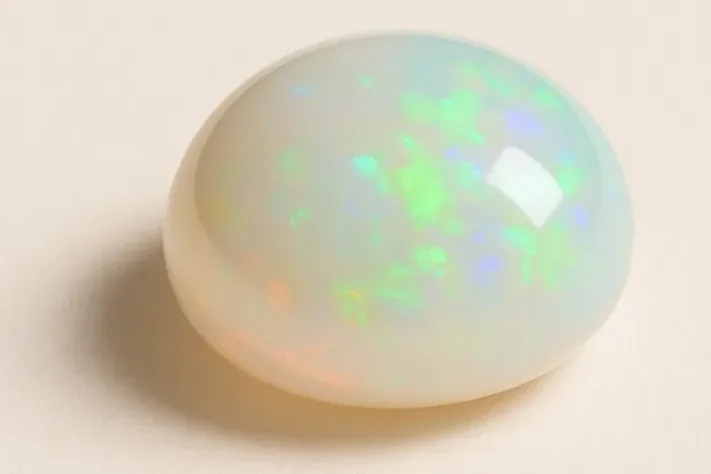
Opal is the one gemstone that is not judged by colour, because it does not have one. What it has is play of colour: patches of pure spectral light that appear, move and vanish as the stone is turned. Two opals of the same body colour and the same weight can differ in price by a factor of a hundred, and the whole of that difference is in how the light behaves.
This makes opal the hardest stone in this series to buy remotely and the easiest to buy badly. It is also the one where the trade vocabulary does the most work: black opal, crystal opal, boulder opal, doublet and triplet are not marketing adjectives, they are different products at different prices, and the word missing from a listing usually tells you more than the words present.
This page covers what makes the colour, what the type names actually mean, how the price is built, the durability question that decides whether opal belongs in a ring at all, and the treated and assembled material that fills the low end of the market.
What play of colour is
Opal is hydrated silica, laid down as microscopic spheres packed in a regular grid. Where the spheres are uniform in size and stacked evenly, they diffract light the way a diffraction grating does, splitting it into spectral colours. Where the packing is irregular, no colour appears and the material is common opal, which the trade calls potch and which is worth almost nothing.
The size of the spheres decides which colours you see. Small spheres return blue and violet; larger ones return green, then orange, then red. Red requires the largest and rarest spheres, which is the physical reason red is the most valuable colour in opal and blue the most common. A stone showing red will nearly always show the rest of the spectrum too, because the larger spheres do not exclude the smaller ones.
Because the effect is diffraction rather than absorption, it is directional. Play of colour appears over a limited range of viewing angles, and a stone can be brilliant face up and dead from thirty degrees off. This is why opal has to be seen in motion, and why a single photograph is close to useless as evidence.
The types, and why the name matters
Type in opal is mostly a description of body tone, meaning the background the colour plays against. A dark background makes the colour read as more saturated, which is why the scale runs the way it does:
| Type | What it is | Roughly |
|---|---|---|
| Black opal | Dark grey to black body tone, play of colour on top | The most valuable by a wide margin |
| Boulder opal | A thin seam of opal left on its ironstone host | Dark backing, often excellent value |
| Crystal opal | Transparent to translucent body, colour throughout | Priced on brightness, can be very high |
| White opal | Pale milky body tone | The most common, generally the least expensive |
| Fire opal | Orange to red body colour, often no play at all | Priced as a colour stone, not as an opal |
Fire opal is the name most often misread. It describes the body colour, not the play of colour, and a great deal of Mexican fire opal shows no play whatsoever. That is not a defect and not a deception, but a buyer expecting flashes because the word fire is in the name will be disappointed.
What decides the price
Five things, in roughly this order of importance:
| Factor | What to look for |
|---|---|
| Brightness | How vivid the colour is against the body, judged in ordinary light rather than under a spotlight |
| Colour range | Red is rarest and dearest, then orange, then green, then blue |
| Pattern | Broad defined patches beat a fine pinfire speckle; harlequin is the rarest and priciest |
| Body tone | Darker backgrounds make the same colour read stronger |
| Directionality | Colour that holds across a wide range of angles is worth far more than colour visible from one |
Brightness is first for a reason. A bright stone with only blue and green will outsell a dull one that technically shows red, and it will keep looking good in the ordinary indoor light where the ring is actually worn. Sellers photograph opal under intense directional light because it flatters everything; ask what it looks like on an overcast day by a window.
Doublets and triplets
A doublet is a thin slice of genuine opal cemented to a dark backing, usually potch or ironstone, to imitate the body tone of black opal. A triplet adds a clear quartz or glass cap over the top, which magnifies the colour and protects the wafer. Both contain real opal, and neither is a fraud when disclosed.
They are, though, a fraction of the price of a solid stone, and the join is often visible from the side as a straight line. Water is their enemy: the cement can lift, and a triplet that gets wet may show clouding under the cap that will not clear. If a listing shows only a face-up view of a very dark, very even opal at a low price, ask for a side profile before anything else.
Where it comes from
Australia has been the dominant source for over a century, and the type names in the table above are essentially Australian trade terms. Lightning Ridge in New South Wales produces the black opal the top of the market is built on; Coober Pedy in South Australia produces white and crystal opal; Queensland produces boulder opal.
Ethiopia has been a major source since the Welo find of 2008 and now supplies a large share of the affordable end. Ethiopian material is often extremely bright and can show excellent colour for the money, but much of it is hydrophane, which behaves differently and is covered below. Mexico is the classic source for fire opal, and Brazil produces a stable, generally lighter material.
Durability, and whether it belongs in a ring
Opal is 5.5 to 6.5 on the Mohs scale, which is softer than window glass and well below the 7 at which airborne dust stops scratching a stone. It also contains water, typically between three and ten percent by weight, and it has no crystal structure to give it toughness. This is the softest and most fragile stone in this series by a clear margin.
The honest position is that opal is a poor choice for a ring worn every day and a fine choice for a ring worn sometimes. It is excellent in earrings and pendants, which meet almost nothing. If it is going into a ring, our guide to settings is worth reading first: a bezel that covers the girdle and sits the stone low is close to essential, and a raised solitaire with exposed edges is asking for a chip.
Crazing is the failure people fear most: a network of fine surface cracks that appears as the stone loses water. It is not predictable and not repairable. Australian solid opal from established fields is generally stable and has a long track record; very fresh material and some seam opal is riskier. Nobody can guarantee a stone will not craze, and a seller who does is telling you something about themselves rather than about the stone.
Ethiopian opal and water
Most Ethiopian opal is hydrophane, meaning it is porous and absorbs water. Submerge it and it can turn transparent and temporarily lose its play of colour entirely, returning to normal over hours or days as it dries. This is a property of the material, not damage, but it has consequences.
A hydrophane stone will also absorb whatever is dissolved in the water: soap, oils, sunscreen, and dye. That last one matters, because it makes Ethiopian material easy to dye into convincing imitation black opal, and dyed stones do circulate. It also means an Ethiopian opal should never be soaked, and should be kept away from hand cream and perfume.
What it costs
Wider than any other stone here, because the top and bottom of the opal market barely resemble each other. Broadly, in dollars per carat:
| Quality | White or light opal | Crystal or boulder | Black opal |
|---|---|---|---|
| Faint colour, dull, narrow viewing angle | $5 - $30 | $20 - $80 | $50 - $300 |
| Good brightness, blue and green, clean pattern | $40 - $150 | $150 - $600 | $500 - $2,500 |
| Bright, broad pattern, orange and red present | $200 - $600 | $800 - $3,000 | $3,000 - $15,000 and far beyond |
Doublets and triplets sit below all of this, typically from a few dollars to perhaps forty dollars per stone regardless of apparent size. Fine black opal is the only stone in this series that reaches diamond prices per carat, and the very best Lightning Ridge material exceeds them.
Meaning and symbolism
Opal is the October birthstone, sharing the month with tourmaline, and the October page sets the two side by side. Older traditions treated it as a stone of hope and of clear sight, and because it contains every colour it was often read as carrying the virtues of all other stones at once.
The superstition that opal brings bad luck is worth naming because it is still repeated. It has no traditional basis at all: it traces to Walter Scott's novel Anne of Geierstein in 1829, in which an enchanted opal loses its fire and its owner dies shortly after. European opal sales are said to have collapsed for decades on the strength of a work of fiction. Before that novel, opal had a consistently positive reputation.
If you are choosing by tradition rather than by month, our astrology and gemstones guide sets out how the zodiac schemes assign stones, which is a separate system again.
Designing around an opal
- Protect the girdle. A bezel or a half-bezel is the single most useful decision, because chips start at an exposed edge. Our settings guide covers the options.
- Sit it low. Height is what catches on doorframes. A low profile costs nothing visually with a stone read from directly above.
- Ask about the backing before the design. A doublet or triplet cannot be reset later without risking the join, so the setter needs to know what they are holding.
- Yellow gold flatters a white or crystal opal, and white metal keeps attention on a black opal's colour. Our metals guide covers the trade-off.
- Consider a pendant instead. It is not a compromise. It is the setting in which this stone lasts, and it lets you buy a better opal for the same money.
A short buying checklist
- Ask for video: the stone turning slowly under ordinary diffuse light, not a spotlight. Play of colour is a moving effect and stills cannot show it.
- Ask for a side profile photograph, which is where a doublet or triplet gives itself away.
- Ask whether it is solid opal, and get the answer in writing.
- Ask the origin, and if Ethiopian, ask directly whether it is hydrophane and whether it has been dyed.
- Check the colour holds as the stone tilts, rather than flashing once at one angle.
- For anything substantial, ask for a report from an independent laboratory naming the material and any treatment.
Frequently asked questions
Is opal too soft for an engagement ring? For daily wear, honestly yes. At 5.5 to 6.5 it will scratch and it can chip. Plenty of people wear opal rings happily, but they treat them as jewellery to take off rather than to forget about.
What is the difference between black opal and a doublet? A black opal is one solid piece of dark-bodied opal. A doublet is a thin slice of opal glued to a dark backing to look like one. Both can be beautiful; the price difference is enormous.
Does opal need to be kept in water? No, and for hydrophane material this is actively bad advice. Solid Australian opal needs nothing special. Storing any opal in water risks more than it prevents.
Will my opal craze? Nobody can promise it will not. Stable Australian solid opal from established fields has a long track record; avoid extreme heat, sudden temperature changes and dry storage, and the odds are good.
Is opal treated? Solid opal is usually untreated, but smoke treatment and sugar-acid treatment are both used to darken body tone, and dyeing is common in porous material. All of it should be disclosed.
Why does my opal look different in the shop and at home? Because play of colour is directional and lighting-dependent. Shop lighting is intense and directional, which flatters opal more than any other stone. Always judge it in ordinary light.
Is fire opal the same as opal with fire? No. Fire opal describes an orange to red body colour and often has no play of colour at all. The two uses of the word catch people out constantly.
How do I clean it? A soft damp cloth, and nothing else. No ultrasonic cleaner, no steam, no soaking, no solvents. Put it on after hand cream and perfume rather than before.
To see how it sits against the rest of the coloured stones, the semi-precious stones guide compares the series side by side, and we are happy to answer questions directly (opens in new tab).