Pearl
Pearls are graded on lustre, not clarity, and sold by millimetre. A guide to Akoya, South Sea, Tahitian and freshwater, and whether one belongs in a ring.
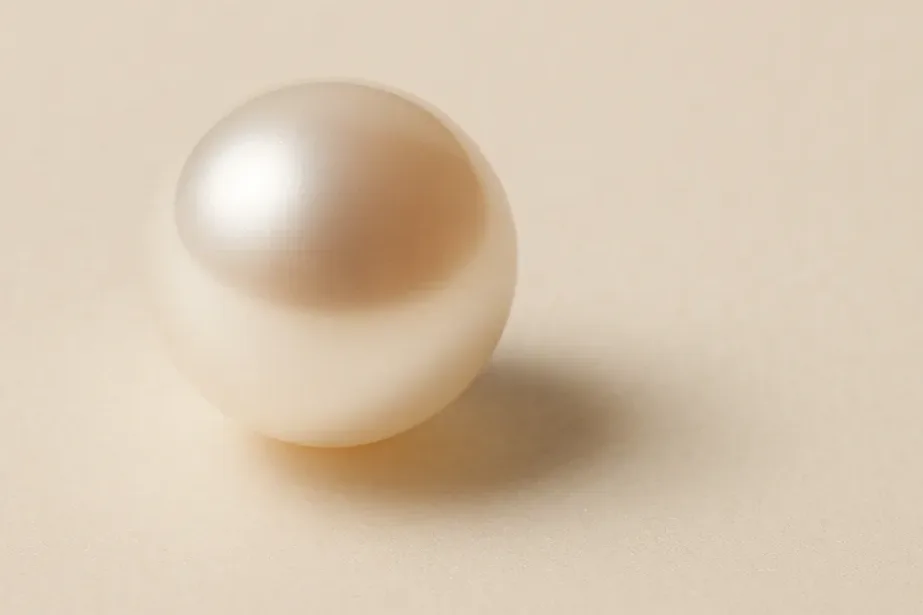
A pearl is the only gem made by an animal. There is no crystal, no cutting and no faceting. A mollusc lays down layer after layer of aragonite platelets bound with conchiolin, and the way light passes through those layers and reflects back is the whole of what you are buying.
That single difference drives everything else. Pearls are graded on lustre rather than clarity, they are sold by millimetre rather than by carat, and they are soft enough that the advice for wearing them is genuinely different from the advice for any other gem on this site.
This page covers the four pearl types you will actually be offered, the value factors in the order that matters, what natural and cultured really mean, and the honest answer on whether a pearl belongs in an engagement ring.
Hardness, and the warning that comes first
Pearl sits at 2.5 to 4.5 on the Mohs scale. Nothing else in this series is close: quartz is 7, topaz 8, sapphire 9. A pearl can be scratched by dust, which is largely quartz, and by a fingernail at the soft end of the range.
Hardness is not the only problem. Nacre is porous and partly organic, so it is attacked by things that would not touch a mineral:
- Acids. Vinegar, lemon juice and even perspiration will etch the surface over time.
- Cosmetics. Perfume, hairspray, lotion and nail products all dull lustre, and the damage is cumulative rather than one-off.
- Heat and dry air. Nacre contains water. A pearl left in prolonged dry heat can craze.
- Ultrasonic and steam cleaners. Never. They will strip nacre and loosen the cement on a drilled pearl.
The practical rule the trade uses is last on, first off: put pearls on after perfume and makeup, take them off before undressing, and wipe them with a soft damp cloth after wearing. Strung pearls need restringing periodically because the silk absorbs body oils and weakens.
None of this makes pearls fragile ornaments to be kept in a drawer. It does mean a pearl on a hand, worn daily, will not look the way it did in the photograph for very long. That matters for the engagement-ring question below.
The four types you will be offered
Almost every pearl sold today is cultured, meaning a technician implanted a bead or a piece of mantle tissue and the mollusc did the rest. The four commercial types differ by species, water and place:
| Type | Where | Usual size | Colors | Notes |
|---|---|---|---|---|
| Akoya | Japan, China (saltwater) | 6 to 9mm | White, cream, rose overtone | The classic round white pearl. Bead-nucleated, so nacre is thin. |
| Freshwater | China (lakes and rivers) | 5 to 12mm | White, peach, lavender | Best value by a distance. Usually solid nacre. |
| South Sea | Australia, Indonesia, Philippines | 9 to 16mm | White, silver, golden | The largest and the most expensive. Thick nacre. |
| Tahitian | French Polynesia | 8 to 14mm | Gray, green, aubergine, peacock | Naturally dark. Thick nacre. Often confused with dyed pearls. |
Freshwater pearls have improved enormously in the last two decades and now compete on lustre with Akoya at a fraction of the price. They are usually tissue-nucleated, which means solid nacre rather than a thin coat over a bead, and that makes them more forgiving of surface wear.
Natural versus cultured
A natural pearl formed without human help. They were fished for millennia, the beds were exhausted by the early twentieth century, and the ones that survive are historical objects sold at auction. If a listing offers a natural pearl at a jewelry-shop price, it is using the word to mean not plastic.
Cultured is not a lesser category, it is the entire modern market. The nacre is real, laid down by a real mollusc, and the only human contribution was starting it. What matters commercially is nacre thickness: a bead-nucleated pearl with a thin coat will show the bead as the surface wears, and can even peel.
Ask for nacre thickness in millimetres where the seller can give it. Anything under 0.5mm on a bead-nucleated saltwater pearl is thin. Good Akoya runs 0.4mm and up; South Sea and Tahitian are commonly 2mm or more, which is part of why they cost what they do.
The value factors, in order
Lustre
The first and by a distance the most important. Lustre is the sharpness and depth of the reflection on the surface. On a fine pearl you can make out clear, bright reflections with definite edges. On a poor one the surface looks chalky and the reflection is diffuse.
This is the factor to insist on in photographs. Ask for an image where a window or a light source is reflected in the pearl: on a good pearl that reflection has a hard edge, on a weak one it smears. A pearl with high lustre and a few surface marks will nearly always look better than a flawless pearl with dull lustre.
Surface
Nacre is grown, not cut, so blemishes are the norm. Small pits, bumps and ridges are expected and are priced in. What matters is whether they are visible at arm's length and whether they sit where the setting will hide them. Cracks and peeling nacre are different, and are a reason to walk away.
Shape
Perfectly round is rarest and most expensive, and roundness is graded strictly because the eye catches a wobble immediately on a strand. Off-round, drop, button, baroque and circle shapes all sell for less, and a good baroque with strong lustre can be far more interesting than a mediocre round.
Color
Body color plus overtone plus, on the best pearls, orient. Overtone is the translucent wash of color over the body, usually rose, silver or green. Orient is the iridescent play you see on thick nacre. White with a rose overtone and black with a green or peacock overtone are the traditional premium combinations, but color is largely preference and it does not follow a single scale the way lustre does.
Size
Measured in millimetres across, not in carats. Price climbs steeply with size because larger pearls take longer to grow and fewer survive the process. A one millimetre step up is a real jump in cost, particularly above 9mm in Akoya and above 13mm in South Sea.
Matching
Only relevant for pairs and strands, where it becomes a major cost. Getting eighty pearls to agree on size, shape, color and lustre requires sorting through an enormous quantity, and that sorting is what you are paying for.
Grading, and why AAA means less than it looks
There is no universal, enforced pearl grading standard. The AAA to A scale you see everywhere is defined by whoever is selling, and one seller's AAA is another's AA. The same is true of the A to D scale used for some freshwater goods.
The GIA describes pearls by the seven value factors above rather than collapsing them into a single letter, and that is the more useful way to read a listing. Where a grade is quoted, ask what it means at that seller: specifically what lustre and what surface it corresponds to. A seller who can answer that precisely is worth more than a seller with an impressive letter.
Treatments
Most pearls on the market are treated in some way, and the common treatments are accepted so long as they are disclosed:
- Bleaching. Near universal on Akoya, to even out body color.
- Polishing and tumbling. Improves surface appearance. Routine and stable.
- Dyeing. Common on freshwater and on black-dyed pearls. A dyed black pearl is not a Tahitian pearl, and the price should be nowhere near.
- Irradiation. Used to darken freshwater pearls and to produce blue and gray shades.
- Luster treatment. Sometimes called maeshori. Improves apparent lustre and is not always disclosed. Its stability varies.
The question to ask is direct: has this pearl been dyed or irradiated, and is the color stable. Any reputable seller will answer in writing.
Is a pearl right for an engagement ring
The honest answer is usually no, and it is worth saying plainly on a site that would happily sell you one.
An engagement ring is the single hardest-worn piece of jewelry most people own. It goes through washing up, hand cream, sunscreen, gym equipment and door frames, every day, for decades. A gem at 2.5 to 4.5 on the Mohs scale, porous and vulnerable to acids and cosmetics, will not come through that looking the way it started. Nacre wears through, lustre dulls, and neither is repairable in the way a scratched metal band is.
If a pearl is what you want anyway, and for many people the look is worth it, the design decisions that help are:
- A protective setting. A bezel or a half-bezel shields the girdle line where wear concentrates. Our settings guide covers the options.
- A low profile. The less the pearl stands proud of the finger, the less it catches.
- A larger pearl than you think. Nacre thickness scales with size, so a bigger pearl has more material to lose before the bead shows.
- Freshwater over bead-nucleated saltwater. Solid nacre wears far better than a thin coat over a shell bead.
- A plan for replacement. Ask, at the point of purchase, what re-pearling would cost in ten years. A good jeweller will quote it without flinching.
An alternative worth considering: pearl as the accent rather than the centre, with a harder stone taking the daily impact. Or a pearl in a piece worn less often, and something at 8 or above on the hand. Our page on choosing a design works through that trade-off.
Meaning, symbolism and the June birthstone
Pearl is the traditional June birthstone, sharing the month with alexandrite and moonstone. It is much the oldest of the three in that role, and for most of history it was among the most valuable gems on earth, before culturing made it available to everyone. The June birthstone page sets the three side by side.
The symbolism is unusually consistent across cultures: purity, integrity and wisdom gathered slowly. The Romans read it as a mark of status, and Renaissance sumptuary law in several states restricted who could wear it. It is the gift for a third and a thirtieth wedding anniversary.
Because pearls are formed as a response to an irritant, they have also picked up a modern reading around patience and things made valuable by difficulty. That is a nineteenth-century gloss rather than an ancient one, but it is the association most people arrive with.
Buying loose pearls
Loose pearls come undrilled, half-drilled or fully drilled, and the distinction decides what can be made from them:
- Undrilled. The most flexible and the right choice if the setting is not yet decided. Also the correct form for a bezel or a claw setting.
- Half-drilled. Drilled part way for a post or a peg, which is the standard for stud earrings and for many rings. Cannot later be strung.
- Fully drilled. For stringing. A fully drilled pearl can still be set, but the hole limits the options and may be visible.
Buy undrilled if you are not certain, since drilling can be done afterwards and cannot be undone. If you already know the piece, half-drilled saves a step.
A short buying checklist
- Ask for a photograph showing a light source reflected in the surface, so you can judge lustre rather than take it on trust.
- Ask for nacre thickness in millimetres on any bead-nucleated pearl.
- Ask whether the pearl has been dyed or irradiated, and whether the color is stable.
- Ask what any quoted grade means at that seller, in terms of lustre and surface.
- Confirm the type: Akoya, South Sea, Tahitian or freshwater, and saltwater or freshwater.
- Confirm drilled, half-drilled or undrilled before you buy.
- For a ring, ask what re-pearling will cost later.
Frequently asked questions
Are cultured pearls real pearls? Yes. The nacre is genuine and laid down by a mollusc. The only human step was starting the process. Nearly every pearl sold today is cultured.
How can I tell a real pearl from an imitation? The traditional test rubs the pearl lightly against a tooth, where real nacre feels gritty and plastic feels smooth. Buying at a distance, that is not available, so rely instead on the seller stating type and origin in writing, and on lustre: imitations reflect flatly and evenly in a way real nacre rarely does.
Why are Tahitian pearls sometimes called black? Their natural body colors range from silver and gray through green, aubergine and near black, all produced by the black-lipped oyster. A cheap black pearl is usually a dyed freshwater pearl, which is a different product entirely.
How long do pearls last? Well-cared-for pearls last generations, and antique strands survive in good condition. Badly treated ones dull within a few years. The variable is care, not age.
Do pearls need special storage? Keep them separate from harder gems that would scratch them, in a soft pouch rather than a sealed plastic bag, since nacre needs some humidity. Not in a safe deposit box for decades.
Is a bigger pearl always better? No. A 12mm pearl with dull lustre is worth less than a 9mm pearl with sharp lustre. Size multiplies the value of good lustre, it does not substitute for it.
What does baroque mean? Any distinctly irregular shape. Baroque pearls cost less than round ones of the same quality, and a well-chosen baroque with strong orient can be more striking than a round pearl at the same price.
Can a scratched or dull pearl be restored? Sometimes. Light surface dulling can be improved by a specialist, but nacre that has worn through to the bead cannot be repaired, only replaced.
If you are comparing pearl with the harder colored stones, the semi-precious stones guide sets the series side by side, and we are happy to answer questions directly (opens in new tab).