Turquoise
The most treated stone in the trade. The four questions to ask about stabilising, dye and reconstitution, and what matrix does to the price.
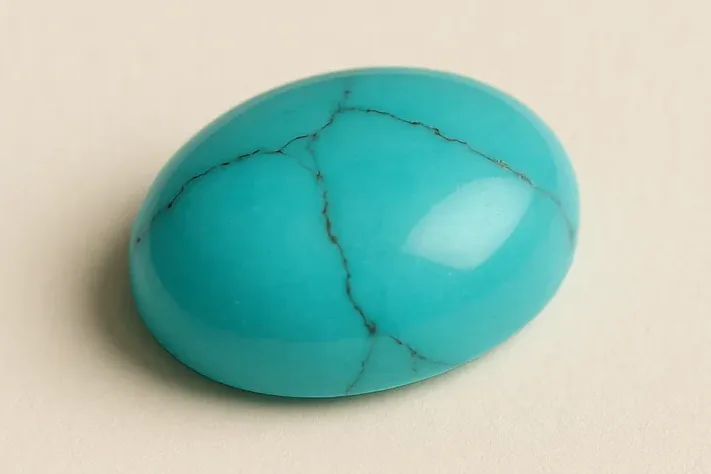
Turquoise is the oldest gemstone in continuous human use. It was being mined in the Sinai before 3000 BC and set into Egyptian jewellery that still exists, and it has been prized independently in Persia, in Tibet, in Mesoamerica and across the American Southwest. Very few materials have been valued by that many unconnected cultures.
It is also, today, the most heavily treated stone in this series. The great majority of turquoise on the market has been stabilised, waxed, dyed, reconstituted or is not turquoise at all, and unlike heat treatment in tanzanite this does affect what the material is worth. Buying turquoise is largely a matter of establishing what you are actually being sold.
This page covers what makes the colour, what the matrix is and why it can raise the price, the full range of treatments and how to ask about them, what the famous mine names mean, and what untreated natural material actually costs.
Colour, and what it is made of
Turquoise is a hydrated phosphate of copper and aluminium, and the copper is what makes it blue. Where iron substitutes for some of the aluminium, the colour moves towards green; where zinc does, it can move towards yellowish green. So the blue-to-green range is a straightforward matter of chemistry rather than of quality.
The market has nonetheless historically paid most for an even, medium, slightly greenish sky blue, the colour usually called robin's egg or Persian blue. That preference is a convention rather than a law of nature, and green turquoise from the American Southwest has its own strong following and its own collectors, particularly where the material is untreated.
Turquoise is almost always opaque, and it takes a soft waxy polish rather than a glassy one. A piece that looks glassy and perfectly even, with a colour that seems slightly too vivid, is usually telling you it has been through something.
Matrix
Matrix is the host rock left in the stone: the dark veins and patches of limonite, pyrite or quartz that the turquoise formed around. In much of the market it is treated as an inclusion and priced down, and clean unbroken blue is what commands the premium in the Persian tradition.
In the American Southwest the convention runs the other way for certain patterns. A fine even web of dark matrix, called spiderweb, is actively prized and a good spiderweb stone from a known mine can outprice clean blue of the same size. Golden or brown matrix from particular mines carries its own premium again.
What matters for a buyer is that matrix is not a defect to be apologised for, and that a completely uniform stone with no matrix at all, at a low price, is more likely to be reconstituted powder than exceptional material.
Treatments, and how to ask
This is the part that decides value. In rough order from most acceptable to least:
| Treatment | What it does | Effect on value |
|---|---|---|
| None | Natural, cut and polished only | Highest, and increasingly scarce |
| Waxed or oiled | Traditional surface finish, deepens colour slightly | Modest reduction, long accepted |
| Stabilised | Clear resin forced into the pores to harden it | Large reduction, but honest and very common |
| Colour-treated | Dye or tinted resin added to shift the blue | Severe reduction, must be disclosed |
| Reconstituted | Ground turquoise powder bonded with resin | Barely a gemstone; priced as a craft material |
Stabilisation deserves a fair hearing rather than a sneer. Perhaps four fifths of natural turquoise coming out of the ground is too soft and porous to cut at all, and stabilisation makes that material usable, durable and stable in colour. A stabilised stone is a legitimate product. It is simply not worth what natural material is worth, and the gap is several multiples.
The question to ask is not is it real, because reconstituted turquoise is technically real turquoise. Ask: is it natural, is it stabilised, is there any dye or colour treatment, and is it reconstituted. Ask all four separately and get the answers in writing.
Imitations
Howlite and magnesite are white porous minerals that dye beautifully and are sold as turquoise constantly, usually with convincing black veining. Dyed reconstituted stone, plastic and glass all circulate too. The classic test of touching a hot needle to an inconspicuous spot will smell of burning plastic on an imitation, but it also damages the piece and is not something to do to something you do not yet own.
The more practical protection is price and provenance. Large, evenly coloured, perfectly matched turquoise beads at a low price are essentially never natural stone. If a seller cannot name the mine or at least the country, treat the material as unknown.
Where it comes from
Iran, historically, from the mines near Nishapur that have produced for a thousand years and set the standard for clean sky blue. The American Southwest is the other great source, and its mines are named and collected in a way that is unusual for any gemstone: Sleeping Beauty in Arizona for even clean blue, Kingman for blue with dark matrix, Bisbee for a deep blue with reddish brown matrix, Lander Blue and Number Eight in Nevada for spiderweb.
Many of the famous American mines are closed or exhausted. Sleeping Beauty stopped producing turquoise in 2012, which is why material attributed to it now commands a premium and why the attribution is worth questioning. China is today the largest producer by volume and supplies much of the world market, including a great deal of what is sold under other descriptions.
Durability and everyday wear
Turquoise is 5 to 6 on the Mohs scale, and natural unstabilised material is porous. It absorbs oils, cosmetics, perfume and perspiration, and over years of skin contact it commonly shifts from blue towards green. Some traditions regard that as the stone taking on the wearer's life and value it; a buyer who wants the colour to stay put will not.
For rings this argues for stabilised material or for a protective setting, ideally both. Our guide to settings covers the options, and a bezel is both traditional for turquoise and genuinely the right engineering answer for a soft opaque stone with no girdle worth gripping.
Never use an ultrasonic or steam cleaner, and never soak it. Wipe with a barely damp cloth. Put the ring on after hand cream, not before.
What it costs
Almost entirely a function of treatment, then colour and matrix pattern, then provenance. Per carat, broadly:
| Material | Typical range |
|---|---|
| Reconstituted or dyed | Well under $1 |
| Stabilised, commercial colour | $1 - $5 |
| Stabilised, fine even blue | $5 - $20 |
| Natural untreated, good colour | $20 - $150 |
| Natural, top colour or fine spiderweb, named mine | $200 - $1,000 and beyond |
The spread between the top and bottom of that table is about a thousandfold for material that can look broadly similar in a photograph, which is why the treatment questions matter more here than anywhere else in this series.
Meaning and symbolism
Turquoise is a December birthstone alongside tanzanite and zircon, and the December page sets the three together. Its symbolism is remarkably consistent across cultures that had no contact with each other: protection, and specifically protection in travel.
Persian tradition held that it guarded against a fall, and it was set into horse bridles for exactly that reason. Navajo and Pueblo traditions associate it with sky, water and wellbeing. Tibetan tradition treats it as a stone of long life. For a material this widely distributed, the convergence on protection is striking.
Designing around turquoise
- A bezel is the natural answer. Soft, opaque and usually cut as a cabochon, turquoise has nothing for prongs to grip well. Our settings guide shows the alternatives.
- Decide about matrix before you shop. Clean blue and fine spiderweb are two different aesthetics at two different prices, and knowing which you want prevents a lot of drifting.
- Silver is the traditional partner and suits the blue, but yellow gold against a greener stone is an underused and very good combination. Our metals guide covers the choice.
- Ask about stabilisation before design, not after. A natural unstabilised stone needs a gentler setter and a more protective mounting.
- Expect it to change. Natural turquoise worn daily will warm towards green over years. Decide now whether that is a flaw or the point.
A short buying checklist
- Ask all four treatment questions separately: natural, stabilised, dyed, reconstituted.
- Ask for the mine or at least the country of origin, and be sceptical of Sleeping Beauty attributions given the mine closed in 2012.
- Look at the polish: a glassy shine on turquoise suggests resin rather than stone.
- Check matrix runs into the stone at the edges rather than sitting only on the surface, which can indicate a painted or backed piece.
- Be suspicious of large matched sets in even colour at low prices.
- For anything substantial, ask for a report from an independent laboratory naming the material and any treatment.
Frequently asked questions
Is stabilised turquoise real turquoise? Yes, it is genuine turquoise with resin added to harden it. It is real, it is legitimate, and it is worth considerably less than untreated material. All three are true at once.
Why did my turquoise turn green? Natural turquoise is porous and absorbs skin oils, cosmetics and perspiration over time. It is normal, it is not damage, and it cannot be reversed.
Is it hard enough for an engagement ring? At 5 to 6 it is soft, and natural material is porous as well. Stabilised turquoise in a bezel is workable for daily wear; unstabilised material in an exposed setting is not.
What is the most valuable turquoise? Untreated natural material, either in a clean even sky blue or in a fine tight spiderweb pattern from a named and exhausted American mine. Both are scarce and priced accordingly.
Is Sleeping Beauty turquoise still available? Only from existing stock. The mine stopped producing turquoise in 2012, so anything sold as Sleeping Beauty is old material, and the name is attached to a good deal of stone that never came from there.
How do I spot dyed howlite? Dyed howlite often shows colour concentrated in the veins rather than in the body, and the veining can look painted on the surface. Price is the strongest signal, and a laboratory settles it.
Can turquoise be worn in water? Better not. Avoid swimming pools, hot tubs and showers, and never soak it. Chlorinated water in particular is bad for both natural and stabilised material.
How do I clean it? A barely damp soft cloth, and nothing more. No ultrasonic, no steam, no detergent, no soaking.
To see how it sits against the rest of the coloured stones, the semi-precious stones guide compares the series side by side, and we are happy to answer questions directly (opens in new tab).