Toi et Moi Rings
The two-stone ring Napoleon gave Josephine, back in fashion. How to pair the stones, the three ways the band holds them, and what two centre stones cost.
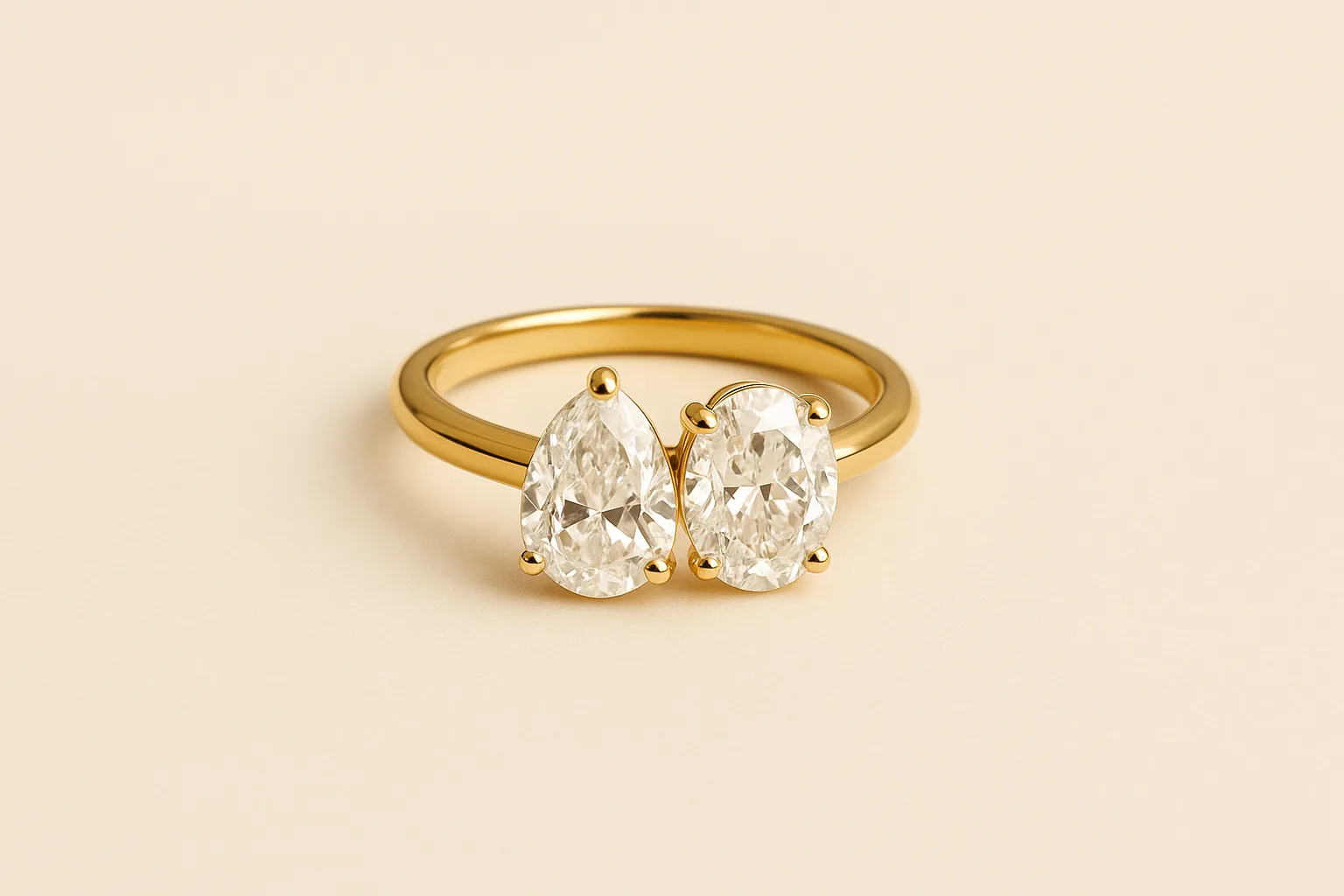
A toi et moi ring carries two stones side by side on a single band. The name is French for you and me, and that is the whole of the idea: two stones of equal standing, touching, neither one a satellite of the other.
It is the oldest engagement ring style still in fashion and the least standardised. There is no house version of it. The two stones can match or contrast, the band can cross behind them or run straight, and every one of those decisions changes what the ring says.
This page covers where the style came from, how to choose two stones that work together rather than compete, the three ways the band can hold them, what it costs to buy two centre stones instead of one, and the practical things about wearing a ring with two high points that nobody mentions until you own one.
Where the style comes from
Napoleon proposed to Josephine in 1796 with a toi et moi: a pear-shaped diamond and a pear-shaped sapphire of similar size, set facing in opposite directions on a plain gold band. The stones were under a carat each and the ring was modest by imperial standards. It sold at auction in 2013 for close to a million dollars, which says more about the buyers than the stones.
The style resurfaced in 1968 when Aristotle Onassis gave Jacqueline Kennedy a ring pairing a large diamond with a ruby. It went quiet again for decades, then returned hard from about 2019 onwards, helped by a run of high-profile engagements and by a wider move away from the single solitaire.
That history matters commercially for one reason: toi et moi is a revival, not a novelty. A jeweller who has made them before has made them for thirty years, and the design problems below have known answers.
What the two stones are meant to say
The conventional reading is two people, two histories, one union, with the band closing around both. It is unusually literal for a piece of jewellery and that is part of the appeal.
Two other readings turn up often enough to mention. Some couples use it for two chapters of one life rather than two people. Others buy it for a milestone rather than an engagement, where the pair marks a before and an after. None of these is more correct than the others, and a jeweller will not ask.
Choosing the two stones
This is where a toi et moi is won or lost. Two stones on one band invite comparison in a way a solitaire never does, and the eye is unforgiving about it.
| Pairing | Reads as | Watch for |
|---|---|---|
| Two rounds, matched | Restrained and symmetrical | Any mismatch in colour or brightness shows at once |
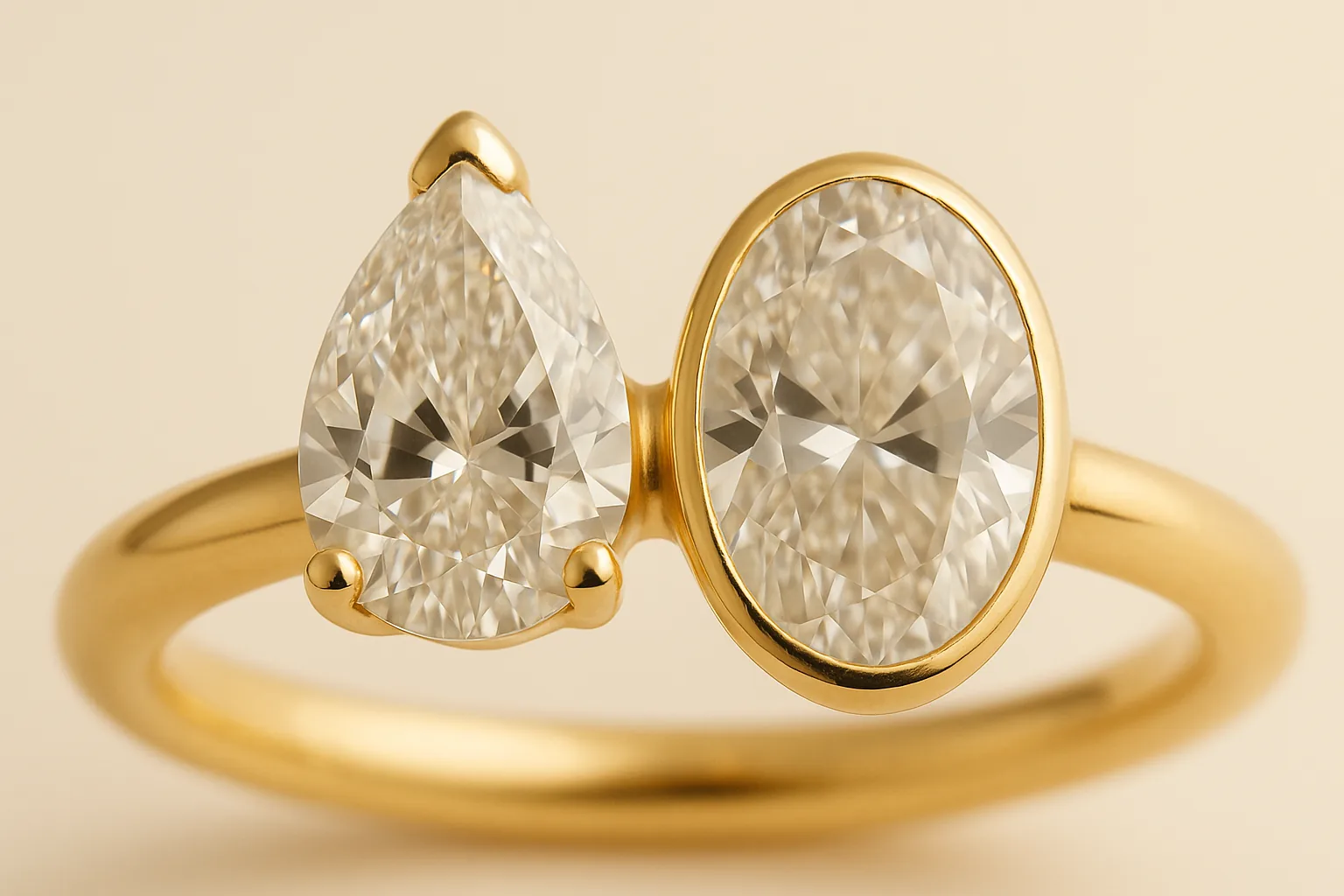
| Pear and oval | The easiest modern pairing | Which way the pear points; usually outward |
| Two pears, opposed | The historic arrangement, most movement | The widest profile, and it catches most |
| Emerald cut and round | A contrast of geometry | Step cuts reveal colour differences more readily |
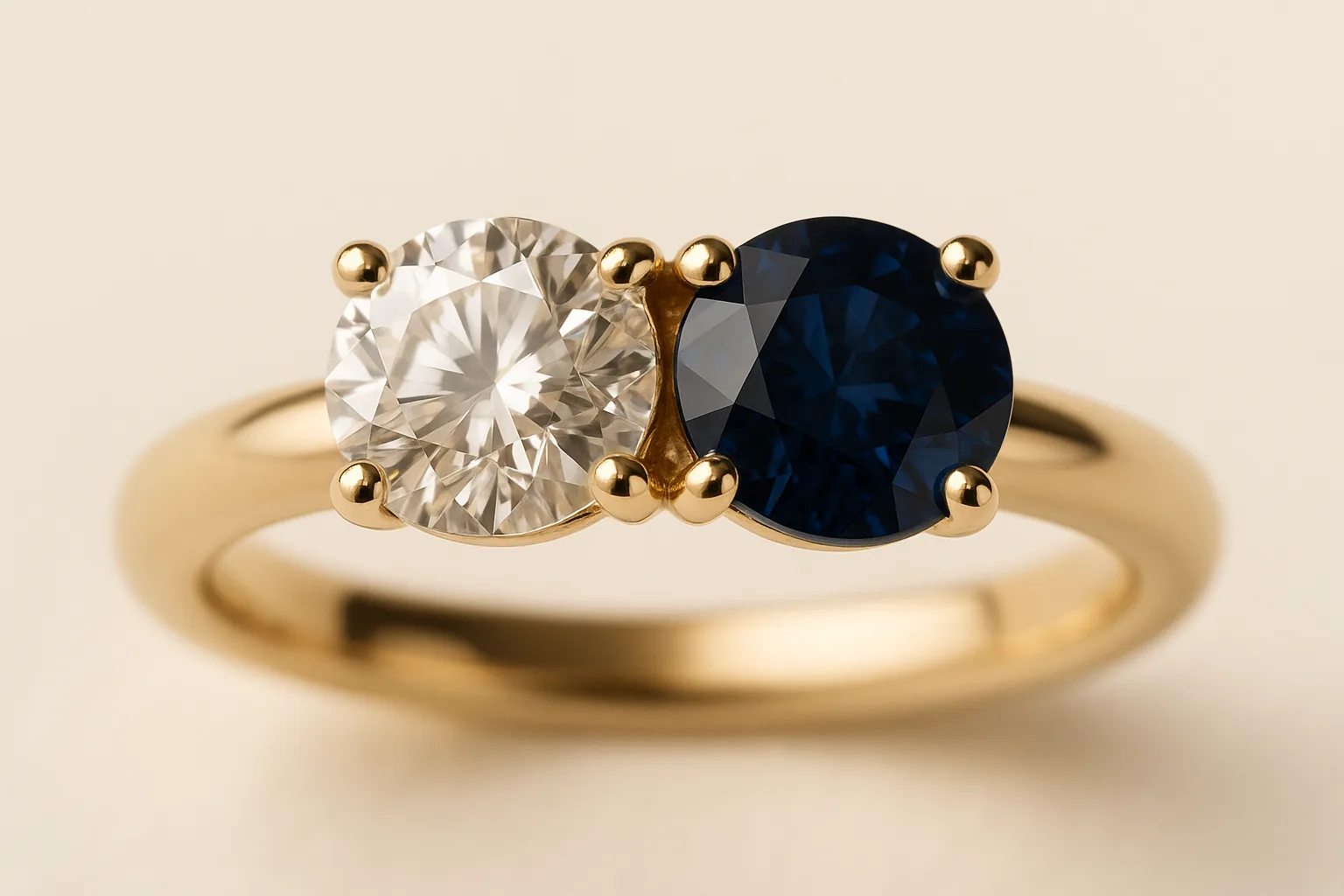
| Diamond and sapphire | Colour contrast, the Napoleon pairing | Matching saturation to the diamond's brightness |
Two rules cut through most of the choices. The stones should be close in size, because a noticeable difference reads as a mistake rather than a decision. And they should sit at the same height, which is a setting problem rather than a stone problem: two stones of equal carat weight but different cuts often have different depths, and a good setter compensates by adjusting the seats rather than by choosing shallower stones.
Two of the same
The most restrained version and the hardest to buy. Two round brilliants of the same weight, colour and clarity read as deliberate and calm, but any mismatch in colour or brightness between them is glaringly obvious because they sit millimetres apart. Buy them as a matched pair from one seller rather than assembling them.
Two shapes that differ
Pear with oval is the most common modern pairing and the easiest to get right, because the two outlines are different enough that the eye stops comparing them. Two pears facing opposite ways is the historic arrangement and the most dramatic; it also produces the widest profile.
Two colours
The historic pairing, and still the most interesting. A colourless diamond beside a sapphire, ruby or emerald gives the ring its whole character from a single decision. Match saturation to brightness: a pale stone next to a bright diamond looks washed out, and a very dark one reads as a hole. Our guide to sapphires covers what to look for in the coloured half.
If you are pairing a diamond with a softer coloured stone, check the hardness of the second stone before committing. Two stones sitting proud of a band take knocks on both sides, and the softer one will show it first. The semi-precious stones guide gives the durability of each.
How the band holds them
Three arrangements cover almost everything on the market, and they are not interchangeable:
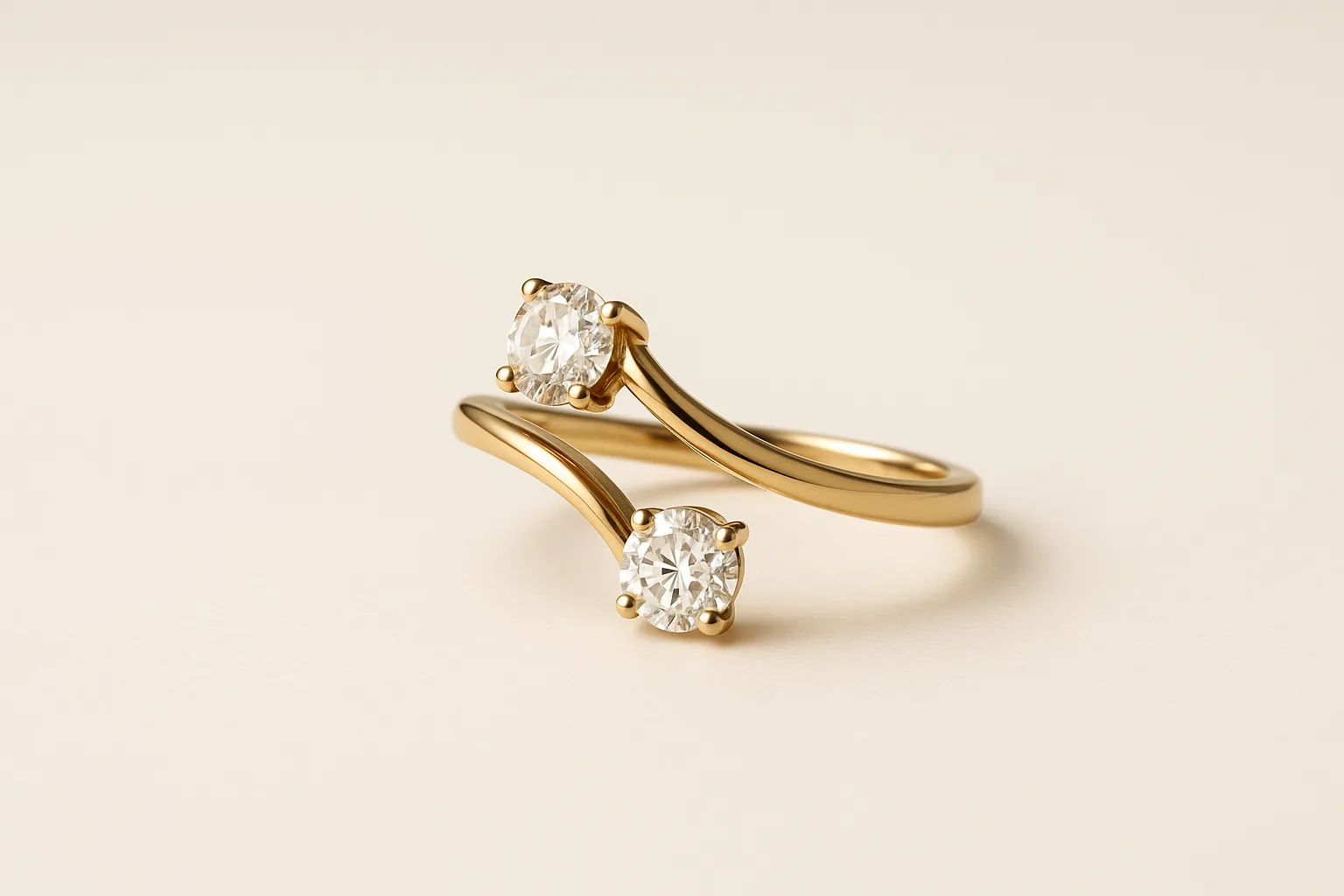
- Bypass, or crossover. The two ends of the band pass each other behind the stones rather than meeting, so each stone sits on its own arm. This is the classic toi et moi shape and the one that reads most clearly as two. It is also the hardest to pair with a flush wedding band.
- Straight, or bar. The two stones sit next to each other on one straight shank, touching or nearly touching. Lower, simpler, and much easier to wear beside a plain band.
- Open. The band stops short on both sides and the stones sit at the two ends with a visible gap between them. The most modern of the three and the least secure; it wants a protective setting on both stones.
The setting method matters as much as the arrangement. Our guide to setting types shows each one photographed; for a toi et moi, a bezel on both stones is worth considering even if you would not choose it for a solitaire, because two raised stones catch roughly twice as often.
What it costs
The blunt arithmetic: a toi et moi has two centre stones. Two half-carat diamonds cost more than one half-carat diamond and less than one full carat, because price per carat rises with size. That last part is what makes the style better value than it looks.
A pair of 0.75 carat stones will usually come in below a single 1.5 carat stone of the same quality, sometimes well below. If the look you want is presence across the finger rather than one large stone, a toi et moi buys more of it per dollar. Our page on ring budgets works through the same trade-off for single stones.
Where the saving disappears is matching. A matched pair of rounds costs more per stone than two unrelated stones, because someone had to sort for the match. Pairing two different shapes or two different colours avoids that premium entirely, which is one more reason the contrasting versions are popular.
Living with a toi et moi
Two high points instead of one changes the ring in ways that only show up after a few months:
- It catches more. Two stones mean two sets of edges and prongs meeting sleeves, gloves and hair. A bezel or half-bezel on each stone is the single most effective fix.
- The profile is wider. A bypass setting in particular spreads across the finger and sits proud of it. Worth trying the width on before committing to the shape.
- A flush wedding band is not guaranteed. A bypass shank rarely sits flat against a straight band. Options are a contoured band shaped to the curve, a plain band worn on the other hand, or choosing the straight arrangement from the start if a stacked look matters to you.
- Resizing is more constrained. The stones sit across the top of the shank rather than on it, so there is less plain metal to cut into. Get the size right at the outset, and see our ring size guide before ordering.
- Cleaning takes longer. The gap between two stones traps more than the space under one. It is a thirty-second job with a soft brush, but it is a job.
Who it suits, and who it does not
It suits someone who wants a ring that is visibly not the default, and who likes the idea being legible. It photographs well and it starts conversations, which some people want from a ring and others actively do not.
It suits a couple pairing two meaningful stones - a birthstone with a diamond, or a stone inherited from a family piece beside a new one. That is the version of this ring that tends to be worn longest.
It suits less well someone who wants to stack rings tightly, someone who works with their hands, or someone who is unsure about the style itself. A toi et moi is a strong statement and it does not fade into the background over twenty years the way a solitaire does. If you are hesitating for that reason, that hesitation is usually right.
A short buying checklist
- Ask for the two stones' measurements, not just their carat weights, and check they are within a fraction of a millimetre of each other in the dimension that shows.
- Ask whether the stones were sold as a matched pair or assembled, and if assembled, ask to see them photographed together under one light.
- Confirm the arrangement: bypass, straight or open. It changes the wedding band conversation.
- For a diamond paired with a coloured stone, confirm the coloured stone's hardness and whether it has been treated.
- Ask what setting holds each stone, and whether the setter will match the two heights at the seat.
- If a wedding band matters, ask to see the contoured band that goes with this ring before ordering the ring.
Frequently asked questions
Is a toi et moi ring an engagement ring? It is one of the oldest, and Napoleon's is the reason. Nothing about it is exclusively an engagement ring, and it is also bought for anniversaries and milestones.
Do the two stones have to be the same size? They should be close. A small difference reads as an error rather than a choice, which is why matched or near-matched pairs dominate. Deliberately unequal versions exist but they need the difference to be large enough to look intentional.
Can I use two different gemstones? Yes, and it is the historic version of the style. Match the saturation of the coloured stone to the brightness of the diamond, and check the softer stone's hardness before committing.
Is it more expensive than a solitaire? Usually less, for the same visual size. Two smaller stones cost less than one large one because price per carat climbs with weight. A matched pair of rounds is the exception.
Will it fit with a wedding band? A straight arrangement usually will. A bypass usually will not sit flush, and wants a contoured band cut to its curve. Ask to see that band before you order.
Which shapes pair best? Pear with oval is the easiest to get right. Two pears facing opposite ways is the most dramatic. Two rounds is the most restrained and the hardest to buy well.
Is it durable enough for daily wear? As durable as its setting and its softer stone. Two raised stones catch more than one, so bezels are worth more here than on a solitaire, and a soft second stone is the thing most likely to show wear.
Is the style going to date? It has come back twice in two centuries, which is a better record than most. It is nonetheless a distinctive ring rather than a neutral one, and that is a matter of taste rather than of fashion cycles.
If you know the shape you want, designing it around your own two stones (opens in new tab) is the straightforward part, and we are happy to answer questions directly (opens in new tab).